
Choosing a chest freezer for off-grid solar means balancing storage capacity, energy use, power flexibility, and reliability. The best option may be a propane freezer, a compact DC cooler, or a conventional chest freezer paired with a suitable inverter and battery bank.
These 10 selections cover different off-grid needs, including camping, RV travel, backup food storage, cabins, and remote living. Use the guide below to compare cooling methods, installation requirements, and practical operating costs before you buy.
Best 10 Chest Freezer for Off Grid Solar Picks for 2026
Best Large Propane Option
7 Cu. Ft. 2-Way Propane Chest Freezer

- 7 cu. ft. capacity for substantial frozen storage
- Runs on 110V or LPG
- Adjustable 10.4°F–32°F thermostat
Best For: Off-grid homes, RVs, and boondocking
Best Premium Solar-Compatible Cooler
Dometic CFX5 75L Dual-Zone Freezer

- 75-liter capacity with two cooling zones
- Freezes down to -7°F
- Supports AC, DC, and compatible solar systems
Best For: Extended camping and nomadic travel
Best Compact Multi-Power Pick
2.4 Cu. Ft. 3-Way Propane Freezer
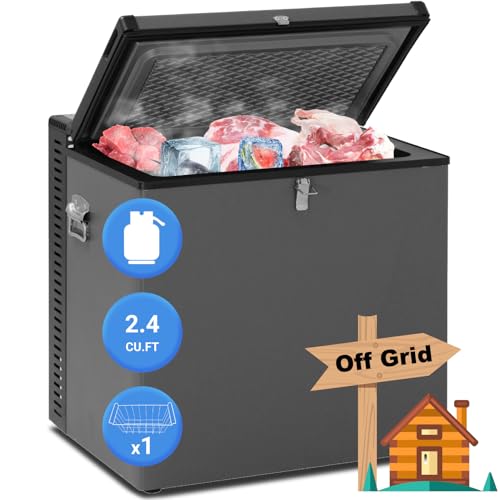
- Runs on 110V, 12V, or LPG
- Compact 2.4 cu. ft. storage
- Includes basket, lock, and quiet absorption cooling
Best For: Small RVs, food trucks, and compact off-grid spaces
Best Portable Solar Package
ACOPOWER LionCooler X40A 42-Quart Freezer

- 42-quart portable capacity
- Includes two 173Wh batteries
- Dual compartments for frozen and chilled items
Best For: Camping and portable solar food storage
Best Off-Grid Gas/Electric Option
7.1 Cu. Ft. Propane Chest Freezer

- Runs on LP gas or 110V AC
- 7.1 cu. ft. capacity
- Silent absorption cooling
Best For: Large off-grid storage with propane backup
Best Garage-Ready Efficiency Pick
Danby 5.0 Cu. Ft. Chest Freezer

- Energy Star compliant design
- Works from 0°F to 110°F
- 48-hour outage protection under ideal conditions
Best For: Permanent solar-powered garages and cabins
Best Direct-DC Solar Option

- Accepts 12V or 24V DC power
- Adjusts from -4°F to 68°F
- Uses about 1.5 kWh per day
Best For: Mobile solar-powered RVs, vehicles, and camps
Reliable Bulk Storage
Koolatron 7.0 cu ft Chest Freezer

- 195 L capacity for bulk frozen-food storage
- 0 to -24°C adjustable temperature range
- Basket, stay-open lid, and front drain
Best For: Simple, practical storage for cabins and off-grid households
Flexible Organization
7.0 cu ft Adjustable Chest Freezer

- Six-level mechanical temperature control
- Two removable baskets and front drain
- Casters support easier repositioning
Best For: Organized storage where mobility and maintenance access matter
Quiet High-Capacity Option
10.0 cu ft Energy-Saving Chest Freezer

- 10.0 cu ft space for bulk frozen goods
- Seven-level temperature dial and removable basket
- Listed operating noise of 40 dB or less
Best For: Larger households needing quiet, high-capacity frozen storage
Best Large Propane Option – 7 Cu. Ft. 2-Way Propane Chest Freezer
If you need a spacious chest freezer for off grid solar alternatives and propane-based living, this 7-cubic-foot model offers flexible 110V or LPG operation. Its adjustable thermostat, locking lid, and large capacity suit home, RV, camping, and boondocking setups.
Best For: Off-grid households, RVs, and campers needing substantial frozen-food storage with propane or 110V power.
Pros:
- 7 cubic feet of storage for frozen food, meat, and ice cream.
- Runs on 110V electricity or LPG.
- Four-grade temperature control from 10.4°F to 32°F.
- Hinge-style lid stays open between 45 and 90 degrees and includes a lock.
Cons:
- Heavy at approximately 149.9 pounds.
- Requires good ventilation when operating with propane.
- Does not list 12V operation.
This is a practical choice when storage capacity matters more than portability. Keep it in a properly ventilated location and compare its large footprint and weight with your available space.
Best Premium Solar-Compatible Cooler – Dometic CFX5 75L Dual-Zone Freezer
For a portable chest freezer for off grid solar use, the Dometic CFX5 75 DZ combines AC, DC, and compatible Dometic battery or solar-panel operation. Its two cooling zones can hold refrigerated and frozen foods together, while the temperature range reaches -7°F.
Best For: Extended camping, nomadic travel, and users who want portable dual-zone cooling with solar compatibility.
Pros:
- 75-liter capacity holds up to 113 12-ounce cans.
- Operates on 110–240V AC or 12/24V DC.
- Can go off-grid with Dometic batteries and Obsidian solar panels.
- Dual zones and three-stage battery protection add flexibility.
Cons:
- Solar operation requires compatible Dometic batteries and Obsidian panels.
- Its 59.8-pound weight is significant for a portable unit.
- Designed as a cooler/freezer rather than a traditional chest freezer.
The CFX5 is a strong fit for mobile setups that prioritize portability, temperature range, and power versatility. Verify compatibility with the solar components you plan to use before buying.
Best Compact Multi-Power Pick – 2.4 Cu. Ft. 3-Way Propane Freezer
This compact chest freezer for off grid solar setups offers three power choices: 110V, 12V, or LPG. With a 2.4-cubic-foot capacity, removable basket, locking lid, and quiet absorption cooling, it is designed for smaller RV, garage, food-truck, and outage-preparedness spaces.
Best For: Compact off-grid installations, RVs, food trucks, and users needing direct 12V or propane flexibility.
Pros:
- Supports 110V, 12V, and propane operation.
- Compact 2.4-cubic-foot size fits tighter spaces.
- Includes a removable basket for organizing smaller items.
- Quiet absorption cooling system and adjustable feet.
Cons:
- Limited capacity compared with full-size freezers.
- Propane mode requires 2.8 kPa gas pressure.
- Solar use is indirect through a suitable 12V power setup.
This model makes sense when space and power-source flexibility are more important than maximum storage. Its 12V input can fit solar-battery systems, but the product notes do not describe a built-in solar controller.
Best Portable Solar Package – ACOPOWER LionCooler X40A 42-Quart Freezer
ACOPOWER LionCooler X40A Combo, 42 Quarts Solar Freezer & Extra173Wh Battery (2 Batteries Included)
Check Price On AmazonThe ACOPOWER LionCooler X40A is a portable chest freezer for off grid solar travel, with a 42-quart capacity and two included 173Wh batteries. Its dual-compartment design provides separate spaces for freezing and keeping food or drinks cold.
Best For: Camping and portable solar-powered food storage where built-in battery capacity and portability are priorities.
Pros:
- Portable 42-quart storage capacity.
- Includes two 173Wh batteries.
- Dual compartments for frozen and chilled items.
- Designed for solar-powered operation.
Cons:
- Smaller capacity than the 75-liter Dometic model or full-size chest freezers.
- Product notes do not specify the temperature range.
- Product notes do not detail AC, DC, or solar-panel input requirements.
This package is appealing for campers who want a ready-to-carry solar cooling solution with extra battery capacity. Review the charging and temperature specifications before relying on it for longer off-grid trips.
Best Off-Grid Gas/Electric Option – 7.1 Cu. Ft. Propane Chest Freezer
For shoppers seeking a chest freezer for off grid solar setups, this SMETA model offers flexible propane and 110V AC operation. Its absorption cooling system, silent operation, and 7.1-cubic-foot capacity suit RVs, garages, and other off-grid spaces, though it is not a direct 12V DC solar appliance.
Best For: Off-grid users who want a large freezer with propane as an alternative to AC power.
Pros:
- Runs on LP gas or 110V AC for flexible off-grid use.
- Provides 7.1 cubic feet of storage with a removable shelf.
- Operates quietly without a compressor or fan and uses about 1.9 lb of propane per 24 hours.
- Includes a lock, adjustable feet, and side handles.
Cons:
- Does not list native 12V or solar-panel input.
- At 189 pounds, it is less convenient to move than a portable cooler.
- Manual defrosting is required.
This is the strongest choice here for buyers who need substantial storage and want to reduce dependence on an inverter by using propane. Solar users should confirm their system can supply 110V AC if they plan to operate it electrically.
Best Garage-Ready Efficiency Pick – Danby 5.0 Cu. Ft. Chest Freezer
Danby DCF050A5WDB 26.38 in. 5.0 cu. ft. Manual Defrost Square Model Chest Freezer
Check Price On AmazonThis Danby chest freezer is a practical chest freezer for off grid solar systems when paired with a suitable inverter and battery bank. Its Energy Star-rated design, garage-ready temperature range, and stated 48-hour power-outage protection make it useful where grid power is limited or unreliable.
Best For: Solar-equipped garages or cabins that need a conventional AC freezer with efficient operation.
Pros:
- Energy Star compliant for lower energy consumption.
- Garage-ready operation from 0°F to 110°F.
- Offers stated 48-hour power-outage protection under ideal conditions.
- Includes a removable basket, counter-balanced hinges, and front-mounted drain.
Cons:
- Requires AC power and does not include a direct solar or 12V input.
- Its 5.0-cubic-foot capacity is smaller than the SMETA propane model.
- Manual defrosting adds maintenance work.
The Danby is a sensible option for a permanent solar installation with enough inverter capacity. Its garage-ready rating is especially helpful for outbuildings, but buyers should size their battery and inverter around the freezer’s AC requirements.
Best Direct-DC Solar Option – SMETA 65L Portable Freezer
For a chest freezer for off grid solar use without relying on a household inverter, this portable SMETA refrigerator/freezer accepts 12V or 24V DC power. Its compressor cooling, adjustable temperature range down to -4°F, battery protection, and wheels make it a strong fit for RVs, vehicles, and mobile solar power stations.
Best For: Mobile solar users who need direct 12V/24V operation and easy transport.
Pros:
- Runs directly from 12V or 24V DC power sources.
- Adjustable temperature range from -4°F to 68°F.
- Uses about 1.5 kWh per day and includes three battery-protection levels.
- Features wheels, retractable handles, and 65 liters of capacity.
Cons:
- Its 65-liter capacity is smaller than the 7.1-cubic-foot propane freezer.
- It is a portable box-style unit rather than a traditional large chest freezer.
- Battery protection slows operation when vehicle power is low, which may affect cooling performance.
This is the most straightforward match for a DC solar setup because it avoids the conversion losses of an AC inverter. Its portable design and relatively low stated daily consumption are useful for mobile applications, while the smaller capacity limits bulk food storage.
Reliable Bulk Storage – Koolatron 7.0 cu ft Chest Freezer
For shoppers comparing a chest freezer for off grid solar, the Koolatron 7.0 cu ft model offers a practical combination of usable capacity and a listed 150-watt rating. Its manual controls, removable basket, and front drain keep operation straightforward for bulk frozen-food storage.
Best For: Households that want 195 liters of storage, simple mechanical temperature control, and easy manual-defrost maintenance.
Pros:
- 7.0 cu ft (195 L) capacity supports bulk storage.
- Temperature range from 0 to -24°C (32 to -11.2°F).
- Removable basket and stay-open lid improve everyday access.
- Front-mounted drain simplifies manual defrosting and cleaning.
Cons:
- Manual defrost requires periodic maintenance.
- Uses a top-opening design, which may require reaching into the lower compartment.
- Warranty is listed as 90 days for parts and labor.
The stated 1.2-amp draw and 150-watt rating make this model worth evaluating against your inverter and battery setup. Confirm startup-power requirements and available solar capacity before relying on it in an off-grid installation.
Flexible Organization – 7.0 cu ft Adjustable Chest Freezer
This 7.0 cu ft model is a practical candidate for a chest freezer for off grid solar setup when you want adjustable mechanical control and convenient maintenance features. Two removable baskets, casters, and a front drain make it easier to organize and service the freezer.
Best For: Users who need organized 7.0 cu ft storage and mobility for a garage, utility area, workshop, or other level indoor space.
Pros:
- 7.0 cu ft interior accommodates bulk packages and prepared meals.
- Six selectable thermostat levels offer straightforward temperature adjustment.
- Two lift-out baskets separate frequently used smaller items.
- Casters, front-access drain, scraper, and ice tray are included.
Cons:
- Manual defrosting is required.
- The supplied notes do not provide a wattage or amperage rating.
- Requires a firm, level surface and adequate ventilation.
Because no electrical consumption figure is supplied, this freezer needs extra verification before pairing with an off-grid solar system. Ask the seller for running and startup power data, then size the inverter and battery around those figures.
Quiet High-Capacity Option – 10.0 cu ft Energy-Saving Chest Freezer
For buyers seeking a larger chest freezer for off grid solar, this 10.0 cu ft model combines substantial storage with a listed low-noise R600a compressor. Its seven-level dial, removable basket, and leveling legs suit flexible placement in a garage, basement, apartment, or similar space.
Best For: Households that prioritize 10.0 cu ft of capacity and quiet operation for bulk meat, seafood, ice cream, or other frozen goods.
Pros:
- 10.0 cu ft capacity provides more room than the 7.0 cu ft options.
- Seven-level front dial allows cooling adjustments.
- Listed operating noise is 40 dB or less.
- Removable basket and leveling legs support organization and stability.
Cons:
- Manual defrosting is required.
- The supplied notes do not state wattage or amperage.
- Its larger capacity may require more solar, battery, and inverter planning.
The quiet operation and R600a compressor are useful features, but “energy saving” does not replace measured power data for an off-grid installation. Confirm actual running consumption and compressor startup demand before choosing this higher-capacity model.
How We Picked the Best Chest Freezer for Off Grid Solar
We selected models across the main categories used in off-grid food storage: propane absorption freezers, three-way units, portable 12V/24V coolers, solar-ready battery systems, and conventional electric chest freezers. We considered capacity, power-source flexibility, portability, temperature control, storage features, and suitability for cabins, RVs, camping, and emergency backup.
Because solar systems vary widely, no single freezer is ideal for every installation. A unit’s advertised capacity does not indicate its actual daily energy consumption, so buyers should verify power specifications and plan for weather-related solar production changes.
Quick Comparison
| Freezer Type | Best For | Main Advantage | Primary Limitation |
|---|---|---|---|
| Propane or two-way | Cabins and long-term off-grid use | Can reduce dependence on batteries | Needs ventilation, fuel, and careful installation |
| Three-way 110V/12V/LPG | RVs and flexible backup power | Multiple operating options | Often smaller and less efficient on battery power |
| Portable DC cooler | Camping, vehicles, and small solar systems | Efficient 12V/24V operation and portability | Limited capacity compared with chest freezers |
| Standard electric chest freezer | Homes, garages, and larger solar installations | Large storage capacity and familiar operation | Requires an inverter and adequate battery reserve |
Key Buying Factors for a Chest Freezer for Off-Grid Solar
Power Source and Compatibility
Check whether the freezer runs directly from 12V or 24V DC, accepts AC power, uses LPG, or supports more than one source. A conventional 110V model can work well, but the inverter must handle both the compressor’s running load and its startup surge.
Energy Consumption
Look for published wattage, amp draw, and estimated daily consumption rather than relying only on a “solar powered” label. Solar panels must cover average use while charging the battery, and the battery should provide enough reserve for cloudy days. Efficient insulation, a full cabinet, and a shaded location can reduce cycling.
Capacity and Layout
Choose capacity based on how often you shop and how much frozen food you store. Larger units provide better bulk storage but require more space and may increase cooling demand. Baskets and removable dividers make frequently used items easier to reach.
Climate, Installation, and Safety
Measure the available space and allow the clearance specified by the manufacturer. Propane models require proper ventilation, approved fuel connections, and safe placement away from combustible materials. In hot climates, insulation and shade become especially important.
Controls and Convenience
Useful features include adjustable temperature controls, low-voltage protection, a lid lock, interior lighting, wheels, and battery monitoring. Manual-defrost models may use less energy but require periodic maintenance.
Who Should Buy Which Chest Freezer for Off Grid Solar?
- Choose a propane or two-way freezer for a stationary cabin or homestead where LPG is readily available and reducing electrical demand is a priority.
- Choose a three-way model if you need flexible operation in an RV, camper, garage, or food truck and want both gas and electrical options.
- Choose a portable DC freezer for camping, vehicle travel, or a modest solar setup where direct 12V/24V operation and portability matter most.
- Choose a standard electric chest freezer for larger food reserves when you already have a dependable inverter, battery bank, and sufficient solar generation.
Before purchasing, compare the freezer’s real power requirements with your panel output, battery capacity, inverter rating, and backup plan. That system-level check is the best way to ensure your chest freezer for off-grid solar remains cold through overnight use and low-production weather.