
Preparing lightweight trail meals at home can reduce pack weight, control ingredients, and make it easier to build a menu around your preferences. The right food dehydrator for backpacking should dry consistently without taking over your kitchen or adding unnecessary complexity.
We selected 10 dehydrators spanning compact five-tray models, stainless-steel designs, larger-capacity machines, and options with long timers and precise temperature controls. Use the guide below to match capacity and features to your trip style.
Best 10 Food Dehydrator for Backpacking Picks for 2026
Best Adjustable-Height Pick

- 95–165°F control in 1°F increments
- Expandable from five to seven trays
- 4.9-pound design with quiet operation
Best For: Home or base-camp trail-food preparation with flexible tray spacing
Best Easy-Clean Option
Hamilton Beach Digital Dehydrator

- Five trays with 4.2 sq. ft. of space
- 48-hour timer with automatic shutoff
- Includes mesh screen and fruit-leather sheet
Best For: Batch preparation of backpacking snacks at home
Best High-Capacity Pick
Cosori 6-Tray Stainless Steel Dehydrator

- 6.5 sq. ft. of drying space
- 600W motor with horizontal airflow
- Six stainless steel trays and specialty sheets
Best For: Large-batch trail-food preparation for groups
Best Lightweight Compact Pick

- 3.9-pound compact design
- Up to 72 hours of operation
- Five adjustable BPA-free trays
Best For: Solo travelers and small-batch trail-food prep in tight spaces
Best Compact Stainless-Steel Pick

- Five dishwasher-safe stainless steel trays
- 95–160°F control and 48-hour timer
- Compact 4.2-pound design with cord storage
Best For: Small-batch backpacking meal prep and easy cleanup
Best Simple Preset Option
Compact 5-Tray Food Dehydrator

- One-touch presets simplify common foods
- 95–167°F range with a 48-hour timer
- BPA-free, stackable five-tray design
Best For: Beginners preparing small backpacking food batches
Best Feature-Rich Choice
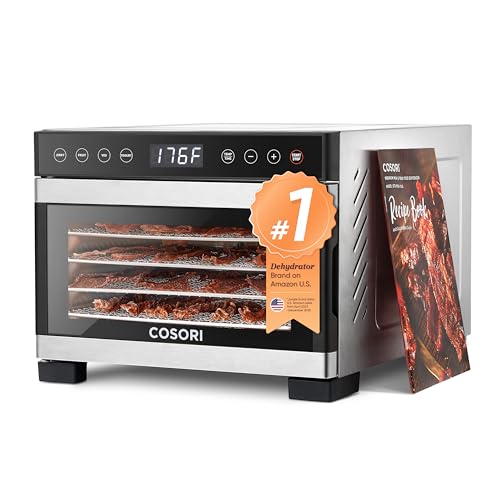
- 3.1 square feet across five stainless steel trays
- 95–176°F control in 1°F increments
- Includes fruit-roll sheet, mesh screen, and four presets
Best For: Larger, precise pre-trip drying sessions
Best Compact Capacity
Rosewill 5-Tray Food Dehydrator

- Five adjustable BPA-free trays
- 48-hour timer and temperature control
- Quiet operation with automatic shutoff
Best For: Batch-prepping varied backpacking foods at home
Best for Large Batches
Magic Mill Pro 10-Tray Dehydrator

- Ten stainless steel trays
- Rear fan promotes even drying
- Includes mesh and fruit-leather trays
Best For: High-volume backpacking meal and snack preparation
Best Lightweight Option
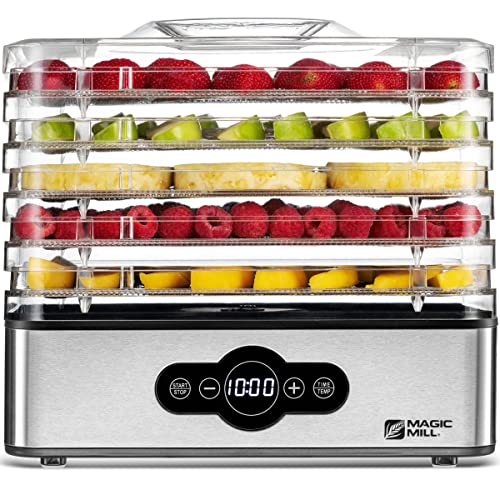
- Compact five-tray design
- 48-hour digital timer
- Listed weight of about 2.75 kg
Best For: Smaller-batch trail-food preparation with easier storage
Best Adjustable-Height Pick – Cosori 5-Tray Food Dehydrator
For a food dehydrator for backpacking, the Cosori 5-Tray model offers useful temperature precision in a relatively manageable 4.9-pound package. Its adjustable tray heights, 95–165°F range, and 48-hour timer make it versatile for jerky, fruit, herbs, and vegetables, though its 12.2-inch round footprint is better suited to base-camp or home preparation than carrying on the trail.
Best For: Backpackers who prepare food at home and want adjustable tray clearance for thicker ingredients.
Pros:
- Adjustable from 95–165°F in 1°F increments.
- Five BPA-free trays can expand to seven with additional trays.
- Runs for up to 48 hours with a quiet operating level below 47 dB.
- Solid construction and a 2-year manufacturer warranty.
Cons:
- The round, 12.2-inch-wide design may take up packing or storage space.
- It weighs more than the smallest compact dehydrators.
This is a practical choice when precise control and expandable capacity matter more than ultra-light portability. Use it to make trail food in advance rather than as an appliance to carry backpacking.
Best Easy-Clean Option – Hamilton Beach Digital Dehydrator
The Hamilton Beach is a practical food dehydrator for backpacking meal prep, with five stackable BPA-free trays and 4.2 square feet of drying space. Its 100–160°F temperature control, 48-hour timer, and automatic shutoff cover common jerky, fruit, and vegetable projects, while the supplied mesh screen and fruit-leather sheet add flexibility.
Best For: Backpackers who want to prepare larger batches of snacks with straightforward digital controls and easy cleanup.
Pros:
- Five trays provide up to 4.2 square feet of drying space.
- Digital timer runs from one to 48 hours and shuts off automatically.
- Base-mounted heater and fan provide even drying without rotating trays.
- Trays and lid are dishwasher-safe when using the recommended non-heated cycle.
Cons:
- At 8 pounds, it is less convenient to transport than compact models.
- Its temperature range starts at 100°F rather than 95°F.
The clear lid makes it easy to monitor progress, and the included accessories support both herbs and fruit leather. It is best for making backpacking food in a kitchen, pantry, or other stationary prep area.
Best High-Capacity Pick – Cosori 6-Tray Stainless Steel Dehydrator
For serious food dehydrator for backpacking preparation, this Cosori model provides 6.5 square feet of drying space across six stainless steel trays. Its 600W motor, horizontal airflow, 95–165°F precision control, and 48-hour timer are suited to large batches of jerky, fruit, and vegetables, but the 18.1-pound weight makes it a home-based prep appliance rather than trail equipment.
Best For: Backpackers and groups preparing substantial quantities of trail food before a trip.
Pros:
- Six stainless steel trays offer 6.5 square feet of drying space.
- 600W motor and horizontal airflow support faster, even drying.
- Temperature adjusts from 95–165°F with degree-by-degree precision.
- Includes dishwasher-safe trays, a mesh screen, and a fruit-roll sheet.
Cons:
- At 18.1 pounds, it is too heavy for typical backpacking transport.
- The 17.8-inch depth requires substantial counter or storage space.
This is the strongest option for high-volume meal preparation, especially when several people need trail snacks. Stainless steel trays and included specialty sheets add usefulness, but capacity comes with considerable size and weight.
Best Lightweight Compact Pick – Small 5-Tray Dehydrator
This compact model is one of the more practical choices for a food dehydrator for backpacking prep when storage space and energy use matter. The 3.9-pound unit has five height-adjustable BPA-free trays, a 250W heating system, 95–158°F control, and up to 72 hours of operation, making it suitable for small batches of fruit, jerky, herbs, vegetables, and pet treats.
Best For: Solo backpackers, apartment kitchens, RVs, and small-batch trail-food preparation.
Pros:
- Compact 3.9-pound design measures 7.28 by 11.81 by 7.87 inches.
- Five transparent, height-adjustable BPA-free trays fit different ingredients.
- 250W system supports energy-conscious small-batch drying.
- Offers up to 72 hours of operation and dishwasher-safe trays.
Cons:
- The 95–158°F range has a lower maximum temperature than some alternatives.
- Its smaller format is less suited to large group-sized batches.
- Operation uses a manual knob rather than digital controls.
The small footprint and low weight make this the easiest model here to store and move, although it remains an appliance for preparing food before a trip. It is a sensible fit when modest capacity and simple operation are more important than high output.
Best Compact Stainless-Steel Pick – OSTBA 5-Tray Food Dehydrator
If you want a practical food dehydrator for backpacking meal prep at home, the OSTBA combines five stainless steel trays with adjustable temperature and a 48-hour timer. Its relatively light 4.2-pound build and compact rectangular footprint make it easier to store before a trip, though it is designed for 120V household use.
Best For: Backpackers preparing fruit, herbs, vegetables, or jerky in organized small batches before heading outdoors.
Pros:
- Five removable stainless steel trays are dishwasher-safe for simpler cleanup.
- Temperature adjusts from 95–160°F, with a timer ranging from 1–48 hours.
- Two tray-height options accommodate thinner slices and thicker pieces.
- Built-in cord storage and non-slip feet improve everyday convenience.
Cons:
- The 160°F maximum is lower than some competing models.
- Its 400W, 120V design is intended for home preparation rather than direct trail use.
The OSTBA is a straightforward choice when stainless steel trays, easy cleanup, and compact storage matter most. Its five-tier layout suits modest backpacking meal-prep sessions without adding unnecessary controls.
Best Simple Preset Option – Compact 5-Tray Food Dehydrator
This compact dehydrator is a convenient option for preparing ingredients for backpacking meals, especially if you prefer one-touch controls. Presets simplify common foods, while the five stackable trays and BPA-free construction support everyday batches of fruit, herbs, vegetables, jerky, and dog treats.
Best For: Beginners who want preset-assisted drying for small backpacking food batches, without complicated programming.
Pros:
- One-touch presets set recommended drying programs for common ingredients.
- Five removable stackable trays provide practical space for small-batch prep.
- Adjustable 95–167°F temperature range and timer up to 48 hours offer added control.
- BPA-free construction and removable trays support routine food preparation and cleanup.
Cons:
- The supplied notes do not specify the unit’s weight or wattage for packability planning.
- Preset-focused operation may offer less detail than a fully manual setup for specialized recipes.
For shoppers seeking a user-friendly food dehydrator for backpacking ingredients, this model emphasizes convenience and compact home storage. Its preset modes are particularly useful when you want a simple starting point for repeatable snack and meal prep.
Best Feature-Rich Choice – COSORI 5-Tray Food Dehydrator
The COSORI is a strong choice for a food dehydrator for backpacking when precise temperature control and versatile accessories are priorities. It offers five stainless steel trays, 3.1 square feet of drying space, horizontal airflow, and a temperature range reaching 176°F, making it well suited to preparing varied trail foods at home.
Best For: Backpackers who want precise controls, useful accessories, and enough capacity for larger pre-trip drying sessions.
Pros:
- Five stainless steel trays provide 3.1 square feet of drying space with no plastic contact with food.
- Temperature adjusts from 95–176°F in 1°F increments, with a 48-hour timer.
- Four presets cover jerky, fruit, vegetables, and yogurt.
- Includes a fruit roll sheet, mesh screen, recipe book, and two-year manufacturer warranty.
Cons:
- At 10.8 pounds, it is substantially heavier than the OSTBA model for storage and transport.
- Its 13.9-by-11.3-by-8.9-inch footprint requires more countertop and storage space.
The COSORI offers the most control and accessory support of these options, but its heavier build makes it better for home-based backpacking prep than carrying between camps. Choose it when capacity, stainless steel construction, and fine temperature adjustments outweigh portability.
Best Compact Capacity – Rosewill 5-Tray Food Dehydrator
The Rosewill 5-tray dehydrator is a practical food dehydrator for backpacking meal prep at home, especially when you want adjustable tray spacing and programmable drying. Its compact rectangular design, 400-watt power, and 48-hour timer suit jerky, fruit, vegetables, herbs, and dog treats.
Best For: Backpackers preparing varied dehydrated foods in batches before a trip.
Pros:
- Five BPA-free trays can be repositioned for ingredients up to 1.5 inches thick.
- Adjustable temperature and timer settings support different foods and drying times.
- Automatic shutoff, non-slip feet, quiet operation, and dishwasher-safe trays add convenience.
Cons:
- At 14.7 pounds, it is intended for home preparation rather than carrying on the trail.
- The stated specifications list differing temperature ranges, so confirm the exact setting range before purchase.
The Rosewill stands out for flexible tray spacing and useful controls in a relatively compact footprint. It is a good choice if you need to prepare several backpacking ingredients at once without prioritizing minimum weight.
Best for Large Batches – Magic Mill Pro 10-Tray Dehydrator
The Magic Mill Pro is a food dehydrator for backpacking cooks who prepare substantial quantities of trail food in advance. Its 10 stainless steel trays, rear-mounted fan, digital controls, and included fruit-roll and mesh accessories give you room to process jerky, fruit, herbs, vegetables, and other ingredients in one batch.
Best For: Large households or frequent backpackers making multiple dehydrated meals and snacks.
Pros:
- Ten stainless steel trays provide considerably more batch capacity than compact five-tray models.
- Rear-mounted airflow is designed for even drying without rotating shelves.
- Includes mesh trays and fruit-leather sheets, plus a keep-warm function and automatic shutoff.
Cons:
- Its 15.5-inch depth and 14-inch height require substantial storage space.
- The 14-pound weight makes it impractical to transport for trail use.
This model favors capacity and versatility over portability. The stainless steel trays, dishwasher-safe accessories, and transparent door make it especially useful when backpacking preparation involves repeated, high-volume batches.
Best Lightweight Option – Magic Mill 5-Tray Dehydrator
The compact Magic Mill 5-tray model is a practical food dehydrator for backpacking meal prep when counter space and storage weight matter. It uses 240 watts, offers a 48-hour digital timer, and provides adjustable temperature control for jerky, fruit, vegetables, and other trail-food ingredients.
Best For: Backpackers who want a compact, relatively lightweight home dehydrator for smaller batches.
Pros:
- Five adjustable stainless steel trays handle multiple ingredients in one cycle.
- Temperature settings from 95°F to 167°F and a timer up to 48 hours offer useful control.
- Its listed weight is about 2.75 kg, and the detachable trays are dishwasher-safe.
Cons:
- Five trays provide less capacity than the 10-tray Magic Mill Pro.
- The supplied specifications list the temperature range inconsistently, so verify the exact range before ordering.
This is the most storage-friendly option in the group based on its listed weight and compact dimensions. Choose it for modest batch sizes and straightforward controls rather than maximum capacity or on-trail portability.
How We Picked the Best Food Dehydrator for Backpacking
We focused on features that matter when preparing trail food: usable drying space, temperature range, timer flexibility, tray construction, footprint, and operating power. Models with adjustable heat are more versatile for vegetables, fruit, herbs, cooked meals, and jerky, while extended timers reduce the need for constant monitoring.
Capacity was also important. A compact five-tray unit may be easier to store and sufficient for occasional weekend trips, while a larger model can process several meal batches at once. Stainless-steel trays were noted for their durability and resistance to absorbing odors, while BPA-free plastic trays can keep weight and cost down.
Quick Comparison
| Best For | Features to Prioritize |
|---|---|
| Occasional backpacking | Compact footprint, simple controls, five trays |
| Meal prep for longer trips | Larger drying area, multiple trays, long timer |
| Jerky and meat | Higher heat capability, precise temperature adjustment |
| Mixed ingredients | Adjustable temperature and evenly spaced trays |
| Durability and frequent use | Stainless-steel trays and sturdy construction |
Key Buying Factors for a Food Dehydrator for Backpacking
Capacity and Storage
Think about how much food you need per batch rather than choosing the largest machine automatically. More trays shorten meal-prep time, but they also increase the appliance’s size and storage demands. Check tray dimensions and total drying area, since tray count alone does not tell you how much food fits.
Temperature and Timer Controls
A broad adjustable temperature range gives you better control over delicate fruit, herbs, vegetables, and meat. A timer of 24 to 48 hours is useful for dense or moist foods and helps prevent over-drying when you cannot check the machine frequently. Preset programs can be convenient, but manual adjustment is more valuable for customized recipes.
Tray Material and Cleaning
Stainless-steel trays are a strong choice for repeated use and can be easier to maintain when drying strongly scented foods. Plastic trays may be lighter and less expensive. Look for removable trays, washable components, and enough spacing for the foods you plan to prepare.
Power, Noise, and Footprint
These are countertop appliances, so confirm that the dehydrator fits your available space. Wattage can affect drying speed, but airflow design matters too. For shared living spaces, a quieter unit may be preferable if a batch will run overnight. Remember that a food dehydrator is generally intended for home preparation; it is not a practical appliance to carry into the backcountry.
Who Should Buy Which Food Dehydrator for Backpacking?
Choose a compact five-tray dehydrator if you make occasional trail snacks, small meal batches, or pet treats and want easier storage. Select a stainless-steel model if you expect frequent use or want a more durable tray surface. A six-tray or 10-tray machine makes more sense for families, extended trips, or cooks who prefer to prepare several ingredients at once.
For jerky and meat, prioritize accurate temperature control, adequate airflow, and a timer long enough for thorough drying. For lightweight backpacking meals, favor consistent low-temperature performance, easy cleanup, and enough capacity to process complete recipes without requiring an oversized appliance. Whichever model you choose, follow tested food-safety procedures and store finished food in airtight packaging before packing it for the trail.