
Choosing among the best MIDI interfaces for beginners can be confusing because the category includes traditional MIDI boxes, USB audio interfaces, and compact keyboard controllers. The right choice depends on whether you need to connect hardware synths, record vocals and instruments, or play software instruments from a keyboard.
This roundup covers approachable options at different price points, with an emphasis on straightforward setup, useful connections, portability, and features that help new musicians start creating quickly.
Best 10 Midi Interfaces for Beginners Picks for 2026
Best Flexible MIDI Router

- 3-in/3-out MIDI routing
- USB-C with broad OS support
- Standalone merge, split, and filter tools
Best For: Beginners building a multi-device MIDI setup
Best Simple Audio Starter
Focusrite Scarlett Solo 3rd Gen
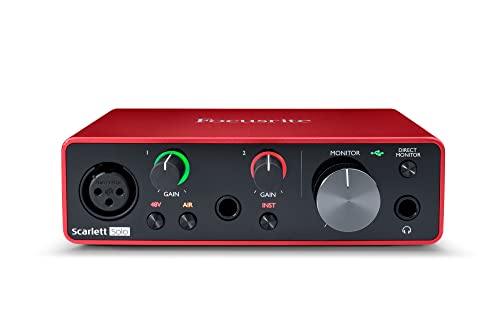
- XLR mic and Hi-Z instrument inputs
- 24-bit/192kHz recording
- Includes beginner-friendly music software
Best For: Beginners recording vocals, guitar, or bass
Best Complete Recording Bundle
PreSonus AudioBox USB 96 Studio

- Includes mic, headphones, and recording software
- MIDI In/Out for keyboards and controllers
- Two mic preamps with phantom power
Best For: Beginners wanting an all-in-one recording kit
Best Software-Rich MIDI Audio Interface

- 5-pin MIDI input and output
- Two combo audio inputs with phantom power
- Includes Ableton Live Lite and creative software
Best For: Beginners combining MIDI with home recording
Best Beginner MIDI Keyboard

- Compact 25-key velocity-sensitive controller
- Includes 40 teaching courses
- USB-MIDI support for Mac, PC, and mobile setups
Best For: First-time producers seeking a portable, easy-to-learn controller
Best Beginner Recording Interface
Focusrite Scarlett Solo 4th Gen

- Mic and Hi-Z instrument inputs
- 24-bit/192kHz recording with 120dB dynamic range
- Includes popular recording software and plugins
Best For: New home recordists adding vocals or guitar to computer-based music
Best Feature-Packed Beginner Controller

- 25 keys, eight drum pads, and OLED display
- Smart scale, chord, arpeggio, and note-repeat functions
- USB-C design with software and teaching courses included
Best For: Beginners wanting guided composition tools and hands-on DAW control
Best Overall
Focusrite Scarlett 2i2 4th Gen

- Two mic preamps and Hi-Z inputs
- Auto Gain and Clip Safe simplify recording
- Includes several DAWs and production plugins
Best For: Beginners recording vocals, guitar, and other instruments
Best MIDI Host
CME H2MIDI Pro Compact Interface

- Connects USB MIDI devices to 5-pin DIN hardware
- Works standalone or through USB-C
- Supports routing, filtering, and mapping
Best For: Hybrid setups using modern and legacy MIDI gear
Best Beginner Controller
Vangoa Worlde Tuna Mini 25-Key

- 25 velocity-sensitive keys and eight RGB pads
- Eight knobs and faders can be reassigned
- Compact controller works with major DAWs
Best For: New producers and songwriters making beats and melodies
Best Flexible MIDI Router – CME U6MIDI Pro
For beginners comparing midi interfaces for beginners, the CME U6MIDI Pro is a focused choice for connecting traditional 5-pin MIDI hardware to a computer or using it as a standalone MIDI router. Its plug-and-play USB-C connection supports major desktop and mobile operating systems, while routing tools add room to grow.
Best For: Beginners who want reliable MIDI connections, routing, filtering, and support for multiple keyboards or synths.
Pros:
- 3-in/3-out MIDI design supports split, merge, thru, and filtering.
- Works with macOS, iOS, Windows, Android, Linux, and Chrome OS.
- Supports broad MIDI data, including controllers, clock, SysEx, MIDI timecode, and MPE.
- Compact, low-weight design with free configuration software and lifetime updates.
Cons:
- It handles MIDI only, not microphone or instrument audio.
- Advanced routing features may be more than a first-time user needs.
The U6MIDI Pro is a strong beginner-to-intermediate option when dependable hardware MIDI connectivity matters more than recording audio. Its routing flexibility also makes it a practical long-term purchase for a growing setup.
Best Simple Audio Starter – Focusrite Scarlett Solo 3rd Gen
The Focusrite Scarlett Solo 3rd Gen is worth considering alongside midi interfaces for beginners when your priority is recording vocals or guitar as well as working with music software. It combines one XLR microphone input, one Hi-Z instrument input, headphone monitoring, and bundled recording software in a compact USB interface.
Best For: Beginners who want to record vocals, guitar, or bass and start producing with a computer.
Pros:
- Dedicated XLR mic preamp and Hi-Z instrument input cover common starter sources.
- Air mode can add clarity to acoustic instruments.
- 24-bit/192kHz recording and low-noise balanced outputs support detailed monitoring.
- Includes Pro Tools Intro+, Ableton Live Lite, Cubase LE, and Hitmaker Expansion.
Cons:
- It is primarily an audio interface rather than a dedicated MIDI interface.
- There is only one mic input and one instrument input.
The Scarlett Solo is a sensible first interface for a singer, guitarist, or home producer. Choose it over a dedicated MIDI box if audio recording is central to your setup; MIDI-focused users may need a separate solution.
Best Complete Recording Bundle – PreSonus AudioBox USB 96 Studio
For beginners searching midi interfaces for beginners who also need microphones and headphones, the AudioBox USB 96 Studio bundle offers a ready-to-use starting point. It includes an audio/MIDI interface, studio headphones, a condenser microphone with stand and cable, and recording software.
Best For: New producers who want an all-in-one home recording setup with MIDI In/Out.
Pros:
- Bundle includes the interface, monitoring headphones, condenser microphone, stand, and cables.
- MIDI In/Out supports synths, drum machines, and controllers.
- Two Class-A mic preamps include +48V phantom power for condenser microphones.
- Zero-latency hardware monitoring and USB bus power simplify recording.
Cons:
- The complete bundle weighs about 5 pounds and is less compact than a small interface alone.
- Maximum sample rate is 96kHz rather than 192kHz.
- It is designed for Windows and macOS, with no mobile operating systems listed.
The AudioBox USB 96 Studio is convenient if you want to start recording immediately without assembling a system piece by piece. Its included MIDI ports make it more versatile than a basic audio-only starter interface.
Best Software-Rich MIDI Audio Interface – Arturia MiniFuse 2
The Arturia MiniFuse 2 is a strong all-rounder for beginners comparing midi interfaces for beginners with audio recording features. It provides 5-pin MIDI input and output alongside two combo inputs, balanced outputs, headphone monitoring, a USB hub, and a substantial software bundle.
Best For: Beginners who want to connect synths or controllers while recording microphones, instruments, and other sources.
Pros:
- Combines 5-pin MIDI I/O with two combo mic/instrument/line inputs.
- Includes 48V phantom power, balanced outputs, headphone control, and loopback.
- Software bundle includes Ableton Live Lite, Analog Lab Intro, Arturia FX, and other creative tools.
- Five-year warranty supports long-term ownership.
Cons:
- It is larger and heavier than a dedicated compact MIDI interface.
- The feature set and software bundle may take time for a complete beginner to learn.
- Listed operating-system support is limited to Windows and macOS.
The MiniFuse 2 is a versatile starting point when MIDI is only part of the plan. It gives beginners enough inputs and software to explore recording, synthesis, vocals, and guitar without immediately needing another interface.
Best Beginner MIDI Keyboard – Donner N-25
For shoppers comparing midi interfaces for beginners, the Donner N-25 is a compact USB MIDI keyboard focused on straightforward music creation. Its 25 velocity-sensitive mini keys, programmable controls, and included lessons provide an approachable starting point for melodies, riffs, and basic arrangement.
Best For: Beginners who want a small, portable controller with guided lessons and essential performance controls.
Pros:
- Compact 25-key design with velocity-sensitive mini keys.
- Beginner-friendly features include an arpeggiator, sustain, octave, tap tempo, and four programmable banks.
- Works with Mac, Windows, iOS, and compatible smartphone or tablet setups via USB-MIDI and an OTG adapter.
- Includes 40 keyboard-teaching courses and supports several popular DAWs.
Cons:
- Mini keys may feel less natural than full-size keys.
- It is a MIDI controller, so it requires a computer or compatible device and software to produce sound.
The N-25 makes sense when portability and ease of use matter more than a larger playing surface. Its teaching content and simple control layout can help first-time producers get started quickly.
Best Beginner Recording Interface – Focusrite Scarlett Solo 4th Gen
Although it is an audio interface rather than a keyboard controller, the Focusrite Scarlett Solo 4th Gen is a practical option for beginners building a home recording setup alongside midi interfaces for beginners. It provides inputs for a microphone and guitar, plus high-resolution recording and bundled software for getting started.
Best For: Beginners who need to record vocals or guitar and want a compact interface with included music-production software.
Pros:
- Provides one XLR microphone preamp and one Hi-Z instrument input.
- Offers 24-bit/192kHz recording and a stated 120dB dynamic range.
- Air mode is designed to add presence and harmonic drive to vocals and guitars.
- Includes Pro Tools Intro+, Ableton Live Lite, Cubase LE, and Hitmaker Expansion.
Cons:
- It does not provide MIDI keyboard keys or dedicated MIDI control.
- Its two-channel input setup may be limiting for larger recording sessions.
The Scarlett Solo is best viewed as a recording companion rather than a MIDI controller. For beginners combining software instruments with live vocal or guitar recording, its simple layout and bundled tools offer a strong foundation.
Best Feature-Packed Beginner Controller – Donner DMK 25 Pro
The Donner DMK 25 Pro is a feature-rich choice for beginners comparing midi interfaces for beginners and wanting more hands-on control than a basic mini keyboard. It combines 25 keys with drum pads, smart scales, an OLED display, arpeggio functions, and DAW controls in a portable USB-C design.
Best For: Beginners who want guided scale features, drum pads, and expanded controls for mobile or computer-based production.
Pros:
- Includes 25 velocity-sensitive keys, eight drum pads, an OLED display, and multiple control wheels.
- Smart Dynamic Scale Mode offers 16 scale tones to simplify bass lines, melodies, and leads.
- Provides arpeggio, note repeat, chord, touch-bar pitch/modulation, and transport controls.
- Includes four DAW software options and 40 keyboard-teaching courses.
Cons:
- It does not produce sound on its own and requires a computer or mobile device with DAW software.
- Mobile use may require a separately purchased OTG adapter depending on the device connector.
- The extensive controls may take time for a complete beginner to learn.
The DMK 25 Pro is a strong fit when creative control and learning aids are priorities. Its smart scales and chord-oriented features can reduce early theory hurdles, while the pads and DAW controls leave room to grow.
Best Overall – Focusrite Scarlett 2i2 4th Gen
If you want beginner-friendly recording hardware alongside MIDI gear, the Focusrite Scarlett 2i2 4th Gen is a strong starting point. It provides two mic preamps, two Hi-Z instrument inputs, USB-C connectivity, and included software for recording and production.
Best For: Beginners who want to record vocals, guitar, or other instruments while building a computer-based music setup.
Pros:
- Two mic preamps and two Hi-Z instrument inputs support flexible recording.
- Auto Gain and Clip Safe help beginners manage recording levels.
- Includes Ableton Live Lite, Pro Tools Intro+, Cubase LE, and Hitmaker Expansion.
- Offers 24-bit/192kHz recording and a 120dB dynamic range.
Cons:
- It is an audio interface rather than a dedicated MIDI interface.
- Only two audio inputs are provided.
The Scarlett 2i2 makes sense for beginners whose setup includes microphones or instruments as well as MIDI controllers. Its guided level features and bundled software reduce the amount of extra gear and setup needed to start recording.
Best MIDI Host – CME H2MIDI Pro Compact Interface
The CME H2MIDI Pro is a dedicated choice for beginners connecting modern USB MIDI devices with older 5-pin DIN hardware. It can operate without a computer, while USB-C connectivity also supports computer and mobile-based MIDI setups.
Best For: Beginners building hybrid MIDI systems with USB keyboards, controllers, synthesizers, drum machines, or traditional DIN MIDI equipment.
Pros:
- Works as a standalone USB host without requiring a computer.
- Supports up to eight USB MIDI devices through a standard USB hub.
- Compatible with macOS, Windows, iOS, Android, Linux, and ChromeOS.
- HxMIDI Tools provides routing, filtering, mapping, and preset management.
Cons:
- It handles MIDI data rather than microphone or instrument audio.
- Advanced routing features may be more than a basic beginner setup needs.
For anyone specifically searching for MIDI interfaces for beginners, the H2MIDI Pro offers useful flexibility in a very small enclosure. Its broad device compatibility and computer-free mode make it suitable for expanding a setup over time.
Best Beginner Controller – Vangoa Worlde Tuna Mini 25-Key
The Vangoa Worlde Tuna Mini is a compact MIDI keyboard controller for beginners who want hands-on control of virtual instruments. It sends MIDI data to a connected computer or device rather than producing sound itself, and includes keys, drum pads, knobs, and faders.
Best For: New producers, songwriters, and learners who want a portable controller for beats, melodies, and DAW control.
Pros:
- Includes 25 velocity-sensitive keys and eight RGB drum pads.
- Eight knobs and eight faders are fully reassignable.
- Supports sustain pedal connection and adjustable velocity curves.
- Works with popular software including FL Studio, Logic Pro, Ableton Live, and GarageBand.
Cons:
- It produces no sound without a connected device and sound source.
- Twenty-five keys provide less range than a full-size keyboard.
- USB connectivity is designed for PC and Mac use according to the supplied details.
The Tuna Mini is a practical entry point for beginners who want to play software instruments instead of relying on mouse clicks. Its compact layout and customizable controls provide useful hands-on functionality without requiring a large studio desk.
How We Picked the Best Midi Interfaces for Beginners
We evaluated these products by looking at the needs beginners are most likely to have: easy computer connectivity, practical controls, compatibility with common music software, portability, and room to grow. We also separated MIDI-focused devices from audio interfaces and keyboard controllers, since they solve different problems.
Traditional MIDI interfaces are best for connecting external keyboards, drum machines, and synthesizers. Audio interfaces such as the Focusrite and PreSonus models add microphone and instrument inputs for recording. Compact controllers from Donner and Vangoa focus on playing virtual instruments and triggering drums rather than routing hardware MIDI.
Quick Comparison
| Best For | Recommended Type | What to Look For |
|---|---|---|
| Connecting several hardware MIDI devices | Multi-port MIDI interface | Enough MIDI inputs and outputs, stable drivers, low latency |
| Recording vocals or guitar while using MIDI | USB audio interface | Mic preamps, instrument input, headphone monitoring |
| Playing software instruments | Mini keyboard controller | Velocity-sensitive keys, pads, knobs, and DAW compatibility |
| Travel and small workspaces | Compact USB MIDI device | Bus power, USB-C support, lightweight construction |
Key Buying Factors for Midi Interfaces for Beginners
Decide Which Connections You Need
USB MIDI is enough if you only plan to control software on a computer or tablet. Choose standard five-pin MIDI inputs and outputs when you need to connect older synthesizers, drum machines, or other hardware. If you own several devices, count the ports before buying; a single MIDI output can become limiting quickly.
Know the Difference Between MIDI and Audio
MIDI carries performance instructions such as notes, timing, and controller movements. It does not record sound. To capture vocals, guitars, or the output of a synthesizer, you need an audio interface with suitable inputs. Some products in this roundup combine MIDI and audio functions, while others are dedicated to one task.
Consider Keyboard Feel and Controls
For beginners who want to play virtual instruments, velocity-sensitive keys are more expressive than basic buttons. Drum pads, arpeggiators, scale modes, and an OLED display can make a small controller more approachable, but they are not essential if you already have a keyboard.
Check Software and Power Requirements
Confirm that the device works with your computer’s operating system and preferred DAW. Bus-powered USB models reduce cable clutter, while some hardware MIDI setups may require additional power or adapters. USB-C is convenient, but check whether a cable is included and whether your computer needs a hub.
Who Should Buy Which Midi Interfaces for Beginners?
Choose the CME U6MIDI Pro 3-in-3-out if you need flexible routing for multiple hardware instruments. The CME H2MIDI Pro is a better fit for compact hardware setups that need USB host functionality.
For recording beginners, the Focusrite Scarlett Solo, Scarlett 2i2, and AudioBox USB 96 bundles are practical starting points. Pick the Solo for a simple one-microphone or one-instrument setup, the 2i2 for two simultaneous inputs, or the AudioBox bundle if included software and a broader starter package matter.
The Arturia MiniFuse 2 suits users who want audio recording plus MIDI connectivity in a compact interface. Choose a Donner or Vangoa keyboard controller if your priority is playing software instruments, building beats, and learning music production without external MIDI hardware. For the simplest portable setup, compare key count, pad layout, and included controls before choosing between them.