
The best MIDI interfaces make it easier to connect hardware keyboards, synthesizers, drum machines, and computers without dealing with confusing routing or unreliable adapters.
This roundup covers compact USB MIDI cables, wireless options, MIDI-thru boxes, and host interfaces, so you can choose the right connection for your studio or live rig.
Best 10 Midi Interfaces Picks for 2026
Flexible USB MIDI Connectivity

- 2-meter USB-to-MIDI cable
- Plug-and-play PC and Mac support
- Optional Windows multi-device driver
Best For: Extended computer-to-MIDI hardware connections
Five-Way MIDI Distribution

- One MIDI input and five outputs
- Supports broad MIDI message types
- USB-C power; no USB MIDI
Best For: Distributing one hardware MIDI source to five devices
Audio-and-MIDI Recording Hub
Focusrite Scarlett Solo 3rd Gen

- One mic preamp and one instrument input
- 24-bit/192kHz recording capability
- Includes DAW and production software
Best For: Solo audio recording with computer-based music production
Programmable USB MIDI Cable

- 6.5-foot plug-and-play MIDI cable
- Filtering, mapping, and routing tools
- Works across major desktop and mobile OSes
Best For: Flexible single-device MIDI connections with software control
Best Wireless MIDI Interface

- Wireless 5-pin DIN MIDI connection
- Works with iOS, Android, Mac, and Windows
- Four modes with claimed 3ms latency
Best For: Cable-free studios and mobile MIDI setups
Best Advanced MIDI Router
CME H4MIDI WC USB Host Interface

- Standalone USB MIDI host operation
- Advanced split, merge, map, and filter tools
- Supports USB-C, DIN MIDI, and optional WIDI
Best For: Complex studio, pedalboard, and live MIDI rigs
Best USB-C MIDI Cable
LEKATO MIDI to USB-C Interface

- One MIDI input and one MIDI output
- Plug-and-play Windows and Mac connection
- LEDs show power and MIDI activity
Best For: Basic keyboard-to-computer MIDI recording
Best Hybrid MIDI Router
CME H2MIDI Pro Compact USB Host MIDI Interface

- Standalone USB host connects USB gear to 5-pin MIDI hardware
- Expandable to up to eight USB MIDI device ports
- Advanced routing, filtering, mapping, and preset control
Best For: Hybrid studio and live rigs using USB and DIN MIDI gear
Best Type-C MIDI Cable Interface
FORE T1 MIDI USB Interface Type-C
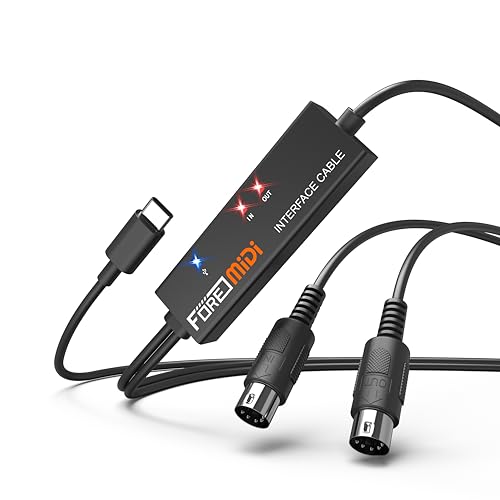
- USB-C connection for computers, phones, and tablets
- Plug-and-play 1-in/1-out MIDI operation
- 6.5-foot integrated cable with activity indicators
Best For: Simple USB-C recording setups with one 5-pin MIDI device
Best USB-A MIDI Cable Interface
FORE MIDI USB Interface Type-A

- Connects one 5-pin MIDI device to a USB-A host
- Plug-and-play operation with LED status indicators
- Supports common DAWs and major desktop operating systems
Best For: Basic computer recording setups with an available USB-A port
Flexible USB MIDI Connectivity – ESI MIDIMATE eX
The ESI MIDIMATE eX is a practical choice for musicians who need a longer USB MIDI connection between a computer and traditional MIDI hardware. Its 2-meter cable, plug-and-play operation, and compatibility with major DAWs make it a straightforward option for expanding a MIDI setup.
Best For: Home studios, live rigs, and computer-based setups using keyboards, synthesizers, or other MIDI devices.
Pros:
- 2-meter cable provides useful reach for larger setups.
- Plug-and-play compatibility with PC and Mac without requiring drivers.
- Supports up to 32 MIDI inputs or outputs and major DAWs.
- Includes an optional Windows MIDI Port driver and a two-year warranty.
Cons:
- Its MIDI-to-USB cable format may be less suitable than a multi-port interface for complex routing.
- The optional multi-device driver feature is listed for Windows rather than all operating systems.
Choose the MIDIMATE eX when you want simple, extended-reach MIDI connectivity with broad computer and DAW support. It is especially convenient for connecting one MIDI setup without adding a separate interface box.
Five-Way MIDI Distribution – CME MIDI Thru5 WC
CME MIDI Thru5 WC 1-in-5-out MIDI Thru | 5-pin DIN, High-speed, Optional Bluetooth
Check Price On AmazonThe CME MIDI Thru5 WC is a dedicated MIDI thru box for sending one MIDI input to as many as five outputs. For musicians comparing midi interfaces, this standalone unit is designed for reliable hardware distribution rather than computer-based MIDI control.
Best For: Studios, live rigs, and pedalboards that need to distribute one MIDI source to multiple devices.
Pros:
- One MIDI input feeds five standard 5-pin MIDI outputs.
- Supports MIDI channels and messages including notes, controllers, clock, SysEx, timecode, and MPE.
- High-speed optocoupler design is intended to reduce errors, ground loops, latency, and jitter.
- Compact housing and USB-C 5V power support flexible placement.
Cons:
- USB-C is for power only, not USB MIDI or computer connectivity.
- It does not provide MIDI merging, mapping, or software-based routing.
The MIDI Thru5 WC is a focused solution when the main requirement is dependable one-to-five MIDI distribution. Select it over a computer-oriented interface when your setup is built around standalone MIDI hardware and standard DIN connections.
Audio-and-MIDI Recording Hub – Focusrite Scarlett Solo 3rd Gen
The Focusrite Scarlett Solo 3rd Gen is an audio interface for recording vocals, guitars, and other instruments, rather than a dedicated DIN MIDI interface. It belongs in a midi interfaces comparison when your priority is combining computer recording with high-quality microphone and instrument inputs.
Best For: Solo musicians, vocalists, guitarists, podcasters, and producers who need a compact USB recording interface.
Pros:
- Includes one XLR microphone preamp and one Hi-Z instrument input.
- Records at up to 24-bit/192kHz with high-performance converters.
- Air mode can add clarity to acoustic instruments and recordings.
- Includes recording software and production tools such as Ableton Live Lite, Cubase LE, and Pro Tools Intro+.
Cons:
- It does not list standard 5-pin MIDI input or output.
- Its two-channel design may not suit larger recording setups.
The Scarlett Solo is a strong pick for creators who need audio recording first and may be comparing interfaces broadly. If you specifically need to connect external MIDI hardware through DIN ports, choose a dedicated MIDI product instead.
Programmable USB MIDI Cable – CME U2MIDI Pro
The CME U2MIDI Pro is a 6.5-foot USB-to-MIDI cable for connecting computers and mobile devices to standard 5-pin MIDI hardware. Its filtering, mapping, and routing features make it a versatile option for musicians who want more control than a basic MIDI cable provides.
Best For: Producers and performers connecting keyboards, controllers, synthesizers, drum machines, or other MIDI instruments to computers and mobile devices.
Pros:
- Plug-and-play support for macOS, iOS, Windows, Android, Linux, and ChromeOS.
- Built-in filtering, mapping, and routing features work with the UxMIDI Tools software.
- Supports all 16 MIDI channels and messages including clock, SysEx, MTC, and MPE.
- 6.5-foot cable, colored MIDI plugs, and LED indicators aid setup.
Cons:
- It provides one MIDI input and one MIDI output, so it is not a multi-port interface.
- Advanced routing and filtering require the companion UxMIDI Tools software.
The U2MIDI Pro is a compelling choice when you want a tidy cable-based connection plus software-controlled MIDI management. Its broad operating-system support also makes it suitable for mobile and computer-based workflows.
Best Wireless MIDI Interface – FORE K1 Wireless MIDI Adapter
The FORE K1 is a practical choice if you want wireless MIDI interfaces that reduce cable clutter around a keyboard, synthesizer, electronic drum kit, or other device with 5-pin DIN MIDI. It pairs with iOS, Android, Mac, and Windows setups, while a USB Type-A companion interface supports computers without built-in wireless connectivity.
Best For: Cable-free home studios, mobile MIDI setups, and musicians using 5-pin DIN equipment with compatible apps or computers.
Pros:
- Wireless Bluetooth connection with plug-and-play pairing and no driver installation.
- Supports iOS, Android, macOS, and Windows, with compatibility across major MIDI software.
- Offers four connection modes, up to 32 feet of transmission distance, and claimed 3ms latency.
- Works with keyboards, synthesizers, electronic drums, mixers, and other 5-pin DIN MIDI devices.
Cons:
- Requires a compatible app, such as GarageBand, to connect directly with iOS devices.
- Designed for devices with 5-pin DIN MIDI ports, so it may not suit USB-only instruments by itself.
- Using the PC wireless mode requires the included MIDI B USB interface.
The FORE K1 stands out among midi interfaces for users prioritizing a cleaner, cable-light setup. Its flexible modes are useful, but the app-based iOS connection and 5-pin DIN requirement are important considerations before buying.
Best Advanced MIDI Router – CME H4MIDI WC USB Host Interface
The CME H4MIDI WC is built for musicians who need more than basic computer connectivity from their midi interfaces. It can operate as a standalone USB MIDI host, connect to a computer over USB-C, and provide routing tools for splitting, merging, mapping, filtering, and MIDI-thru applications.
Best For: Guitarists, producers, and advanced performers building standalone pedalboard, studio, or hardware MIDI routing systems.
Pros:
- Connects class-compliant USB MIDI instruments directly to MIDI hardware without a computer.
- Supports up to eight USB MIDI device ports through a standard USB hub.
- Offers USB-C computer connectivity with up to four virtual inputs and four outputs.
- Includes configurable routing, filtering, mapping, four presets, and flexible 5V USB or 9V DC power.
Cons:
- Advanced routing features require setup through the HxMIDI Tools app.
- WIDI Bluetooth MIDI requires the optional WIDI Core module.
- Its feature-rich design may be more involved than necessary for simple one-device connections.
For complex hardware rigs, the H4MIDI WC is one of the most versatile midi interfaces in this group. Its standalone operation and deep routing options are especially useful on stage, though simpler setups may not need all of its controls.
Best USB-C MIDI Cable – LEKATO MIDI to USB-C Interface
The LEKATO MIDI Cable is a straightforward wired option for connecting a keyboard, synthesizer, digital piano, or drum pad to a Mac, Windows computer, or iPad. Among midi interfaces, its main appeal is simple plug-and-play operation, with separate input and output activity indicators to help monitor the connection.
Best For: Standard one-device recording, editing, and computer-based MIDI setups that use USB-C and 5-pin MIDI connections.
Pros:
- Provides one MIDI input and one MIDI output with support for up to 16 channels.
- Plug-and-play design requires no special drivers for supported Windows and Mac systems.
- Red power and blue signal LEDs make incoming and outgoing MIDI activity easier to troubleshoot.
- Soft bare-copper cable construction and interference-resistant design support stable signal transmission.
Cons:
- It is a wired cable rather than a wireless MIDI solution.
- Compatibility may require specific settings for some older or vintage synthesizers.
- The one-in/one-out design is less suitable for larger multi-device MIDI networks.
The LEKATO is a sensible pick when you want a simple USB-C connection without extra routing features. Its indicators and plug-and-play design make it approachable for basic recording and editing, while users with complex rigs should consider a more expandable interface.
Best Hybrid MIDI Router – CME H2MIDI Pro Compact USB Host MIDI Interface
The CME H2MIDI Pro is one of the most flexible MIDI interfaces for hybrid setups that combine modern USB gear with traditional 5-pin DIN hardware. It can operate without a computer, connect to multiple USB MIDI devices through a hub, or provide USB-C computer connectivity across major operating systems.
Best For: Producers, performers, and guitarists who need advanced MIDI routing between USB and legacy DIN equipment.
Pros:
- Works as a standalone USB host without a computer.
- Supports up to eight USB MIDI device ports through a hub.
- Offers routing, filtering, mapping, splitting, and preset storage through HxMIDI Tools.
- Handles complex MIDI data, including clock, sysex, MTC, and MPE.
Cons:
- Its advanced routing features may be more than simple computer-to-keyboard users need.
- The compact unit provides one 5-pin DIN MIDI input and output.
- Advanced configuration requires the HxMIDI Tools software.
Choose the H2MIDI Pro if your setup spans USB controllers, synths, sequencers, and older MIDI hardware. Its standalone operation and configurable signal handling make it especially useful for complex live or studio rigs.
Best Type-C MIDI Cable Interface – FORE T1 MIDI USB Interface Type-C
The FORE T1 is a straightforward MIDI interface for connecting a 5-pin MIDI keyboard, synthesizer, drum machine, or controller to a USB-C device. Its integrated 6.5-foot cable, plug-and-play design, and built-in status indicators make it a practical choice for recording and editing with compatible computers, phones, and tablets.
Best For: USB-C laptops, iOS devices, and Android devices that need a simple 5-pin MIDI connection.
Pros:
- Provides one MIDI input and one MIDI output with 16 channels.
- Plug-and-play operation requires no additional driver installation.
- Works with Windows, macOS, iOS, and Android systems.
- LED indicators show power and MIDI signal activity.
Cons:
- A USB A-C adapter is not included.
- It connects one MIDI device directly rather than serving as a multi-device router.
- The cable-based design offers less configuration flexibility than a dedicated desktop interface.
The T1 is a good fit when you want a simple connection between one DIN-equipped MIDI device and a USB-C host. It covers common DAW and mobile music applications without adding the complexity of advanced routing hardware.
Best USB-A MIDI Cable Interface – FORE MIDI USB Interface Type-A
The FORE MIDI USB Interface Type-A is a simple way to connect a traditional 5-pin MIDI keyboard, synthesizer, electronic drum, or controller to a computer. This plug-and-play MIDI interface includes integrated cabling, LED status indicators, and compatibility with common Windows, macOS, iOS, and Android music setups.
Best For: Computer-based recording and editing setups with an available USB-A port.
Pros:
- Offers one MIDI input and one MIDI output with 16 channels.
- Built-in driver and plug-and-play setup avoid complicated installation.
- Compatible with common software such as GarageBand, FL Studio, Cubase, and Sonar.
- Includes a 6.5-foot cable with LED power and signal indicators.
Cons:
- A USB A-C adapter is not included for newer Type-C-only devices.
- It is designed for a single direct MIDI connection rather than multi-device routing.
- Its USB-A connection may be less convenient with newer computers and mobile devices.
For a basic computer-centered MIDI setup, the FORE Type-A interface keeps the connection uncomplicated. It is most suitable when your host already has USB-A and you need reliable two-way communication with one 5-pin MIDI device.
How We Picked the Best Midi Interfaces
We focused on connection type, compatibility, reliability, portability, and the kind of MIDI routing each product supports. The selection includes simple USB-to-MIDI cables for straightforward computer connections, dedicated MIDI-thru hardware for distributing one signal to several devices, and USB host interfaces for connecting MIDI equipment without a computer.
We also considered practical details such as plug-and-play operation, USB connector style, input and output availability, wireless convenience, filtering or mapping features, and whether a product suits recording, live performance, or hardware-only setups.
Quick Comparison
| Type | Best For | What to Look For |
|---|---|---|
| USB MIDI cable | Connecting one MIDI device to a computer | Reliable drivers, correct connector, input and output support |
| MIDI-thru box | Sending one MIDI signal to multiple devices | Number of outputs and dependable signal duplication |
| USB host interface | Connecting USB MIDI gear to traditional MIDI hardware | Host capability, power requirements, and port compatibility |
| Wireless MIDI adapter | Reducing cable clutter | Range, latency, pairing, and device compatibility |
| Audio interface with MIDI | Recording audio and MIDI together | Audio inputs, MIDI ports, monitoring, and computer connectivity |
Key Buying Factors for Midi Interfaces
Connection and Port Compatibility
Traditional MIDI uses five-pin DIN connectors, while newer controllers often use USB-A, USB-C, or wireless connections. Check both ends of your intended setup before buying. A USB MIDI cable is usually the simplest choice when connecting a keyboard or synth directly to a computer.
Routing and Expansion
If you need to control several hardware devices from one MIDI source, choose a MIDI-thru unit rather than a basic adapter. For computer-free setups, a USB host interface can bridge USB MIDI controllers and DIN-equipped synthesizers, but verify how it receives power.
Latency, Filtering, and Mapping
Basic connections may be enough for piano or controller input, while more advanced setups benefit from filtering and MIDI mapping. Wireless models can be convenient, but wired connections are generally preferable when minimum latency and maximum stability matter.
USB Connector and Operating Setup
USB-C is increasingly common on current laptops and tablets, while USB-A remains useful with older computers and accessories. Confirm whether the interface is plug and play, requires external power, or needs a powered hub for your equipment.
Who Should Buy Which Midi Interfaces?
Choose the ESI MIDIMATE eX, CME U2MIDI Pro, or a comparable compact cable when you need an uncomplicated computer-to-MIDI connection. The LEKATO and FORE Type-C options are especially suitable for newer laptops, tablets, and USB-C-equipped devices.
Choose a CME MIDI Thru5 WC when one controller must feed multiple hardware instruments. The CME H2MIDI Pro or H4MIDI WC is better for USB host duties and computer-free hardware rigs. Consider the FORE wireless option when mobility and a cleaner setup matter more than using a fully wired connection.
If you also record microphones or instruments, the Focusrite Scarlett Solo 3rd Gen is the more versatile choice because it combines audio-interface functions with MIDI connectivity considerations. Before ordering, map every device in your setup and confirm the required ports, power, and routing direction.