
The best patch bay with front panel switches makes it easier to reroute equipment, troubleshoot connections, and keep a rack or studio organized. The right choice depends on whether you need balanced audio normalization, Ethernet patching, keystone flexibility, or a compact installation.
This roundup compares 10 options across audio and network applications, with attention to connector layout, rack compatibility, wiring access, signal performance, and day-to-day usability.
Best 10 Patch Bay with Front Panel Switches Picks for 2026
Top Flexible Pick

- 48 balanced 1/4-inch connections
- Front switches for three routing modes
- 19-inch, 1U rack-mountable design
Best For: Flexible studio routing with front-panel access
Best XLR Organizer

- 16-channel XLR patchbay
- Rugged shielded steel enclosure
- Reversible ears for 1U rack mounting
Best For: Organized XLR connections in fixed rack installations
Best Network Alternative
Cable Matters 24-Port Cat6 Panel

- 24-port RJ45 Cat6 design
- Supports 10-Gigabit Ethernet and PoE
- Standard 1U rack or wall mounting
Best For: Organizing Ethernet cabling in network racks
Most Configurable Routing

- 48-point balanced TRS patchbay
- Four selectable routing functions
- Rugged construction for studio use
Best For: Studios needing highly adaptable signal routing
Flexible Keystone Foundation
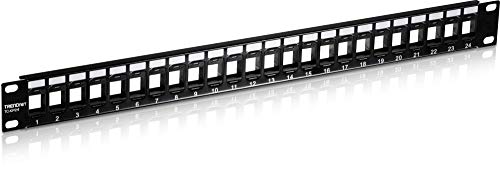
- Supports standard Cat6 keystone jacks
- Numbered ports simplify cable identification
- Sturdy SPCC steel 1U rack design
Best For: Custom installations using separately purchased keystone jacks
High-Speed Punch-Down Choice
24-Port 10Gbps Rackmount Panel
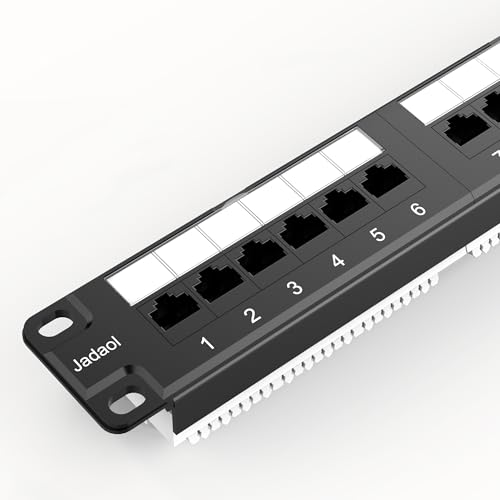
- Supports up to 10Gbps Ethernet
- PoE, PoE+, and PoE++ compatible
- 110-type IDC punch-down termination
Best For: High-bandwidth rack and cabinet network installations
Tool-Free Expansion Pick
24-Port Cat6 Inline Keystone Panel

- Preloaded couplers enable tool-free termination
- Supports connections up to 10Gbps
- Removable back bar aids cable support
Best For: Fast, adaptable Cat5e or Cat6 installations
Best Plug-and-Play Pick
24-Port Jadaol Pass-Through Panel

- 24 removable RJ45 couplers plus one spare
- 10Gbps Cat6 support
- Rack- or wall-mount design with cable management
Best For: Tool-free home, office, or rack network installations
Best Fully Equipped Rack Option
Cable Matters 24-Port Cat6 Panel
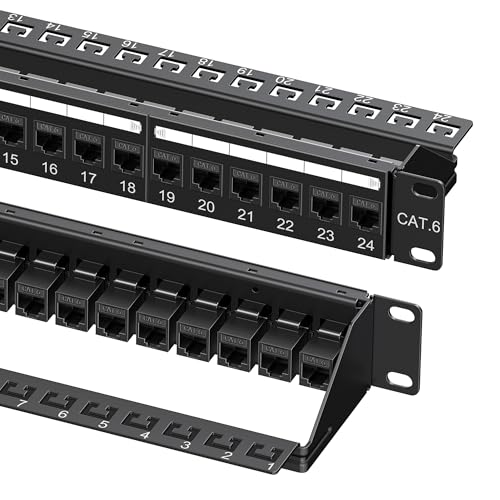
- 24-port 10Gbps Cat6 performance
- Supports PoE through PoE++
- Includes keystone flexibility and rack accessories
Best For: Expandable rack networks with organized cabling and PoE
Top Flexible Pick – Samson S-Patch Plus
Samson S-Patch Plus Balanced 48-Point 1/4" Patch Bay | 1/4 Inch Phone Connections
Check Price On AmazonIf you need a patch bay with front panel switches, the Samson S-Patch Plus makes routing changes accessible from the rack face. Its 48 balanced 1/4-inch connections support Normalled, Half-normalled, and Thru configurations.
Best For: Studios that need flexible routing and convenient front-panel control.
Pros:
- Front switches select Normalled, Half-normalled, or Thru operation.
- Provides 48 front and 48 rear 1/4-inch connections.
- Fully balanced design in a 19-inch, 1U rack-mountable chassis.
Cons:
- Its 1/4-inch TRS format is not intended for XLR-only patching.
- The many routing options may require careful labeling during setup.
The S-Patch Plus is a strong choice when front-panel switching and balanced studio connectivity matter more than a basic fixed patch layout.
Best XLR Organizer – ART P16 XLR Balanced Patchbay
The ART P16 is a straightforward XLR patchbay for installations that prioritize durable, organized connections over front-panel switching. It places 16 female XLR connectors on the front and 16 male XLR connectors on the rear.
Best For: XLR-based racks needing a rugged, compact connection point.
Pros:
- Offers 16 XLR channels with front female and rear male connectors.
- Uses reliable PCB wiring and a fully shielded steel enclosure.
- Fits standard 19-inch, 1U racks and includes reversible rack ears.
Cons:
- Notes do not specify front-panel switches or selectable routing modes.
- XLR connectivity is less suitable for setups built around 1/4-inch TRS patching.
Choose the P16 when your priority is tidy, durable XLR access. It is less appropriate if a patch bay with front panel switches is a must-have feature.
Best Network Alternative – Cable Matters 24-Port Cat6 Panel
The Cable Matters 24-port panel is a networking product rather than a patch bay with front panel switches. It provides a 1U rackmountable RJ45 termination point for Cat6 Ethernet cabling, with numbered ports and T568A/T568B wiring guides.
Best For: Home-office and rack-based Ethernet cable organization.
Pros:
- Supports Cat6 cabling and 10-Gigabit Ethernet applications.
- Provides 24 numbered RJ45 ports in a standard 1U form factor.
- Includes gold-plated contacts, cable-management hardware, and UL listing.
Cons:
- It is not an audio patchbay and does not provide audio routing modes.
- Notes do not indicate front-panel switching functionality.
This panel belongs in a network rack, not an audio studio. It is worth considering only if “patch bay” refers to Ethernet organization rather than switchable audio routing.
Most Configurable Routing – Behringer PX3000
Behringer ULTRAPATCH PRO PX3000 Multi-Functional 48-Point 3-Mode Balanced Patchbay
Check Price On AmazonThe Behringer ULTRAPATCH PRO PX3000 suits buyers seeking a patch bay with front panel switches and multiple routing choices. Each channel can be configured for Parallel, Half-normalled, Normalled, or Open operation to reduce cable clutter and adapt to different studio setups.
Best For: Studios that want broad routing flexibility from a 48-point balanced TRS patchbay.
Pros:
- Offers four selectable operating functions: Parallel, Half-normalled, Normalled, and Open.
- Provides 48-point TRS patchbay connectivity.
- Uses high-quality components and rugged construction.
Cons:
- The extensive configuration options may take more planning to implement.
- Its listed connectivity is centered on TRS, so connector compatibility should be checked first.
The PX3000 is a compelling option when routing versatility is the deciding factor. Its selectable modes give it an edge over simpler patchbays, provided your equipment matches its TRS connections.
Flexible Keystone Foundation – 24-Port Blank 1U Patch Panel
If you need a patch bay with front panel switches but want to build your own connection layout, the TRENDnet TC-KP24 provides a blank 24-port keystone frame. It fits standard Cat6 keystone jacks, uses a sturdy 19-inch 1U metal design, and includes numbered ports for easier cable identification.
Best For: Custom network, audio, video, or data installations using separately purchased keystone jacks.
Pros:
- Accepts standard-sized Cat6 keystone jacks for a configurable setup.
- 24 sequentially numbered ports and supplementary labels simplify cable tracking.
- SPCC steel construction supports rack-mounted installations.
- Backed by a two-year TRENDnet manufacturer warranty and English-language technical support.
Cons:
- Keystone jacks are sold separately, so the panel is not ready to connect out of the box.
- It is a blank panel rather than a preloaded patch bay with built-in front-panel switches.
The TC-KP24 is a practical starting point when flexibility matters more than an all-in-one panel. Choose it if you already have compatible keystones and want to tailor the ports to your installation.
High-Speed Punch-Down Choice – 24-Port 10Gbps Rackmount Panel
For a patch bay with front panel switches alternative focused on wired network distribution, the Jadaol 24-port panel offers punch-down termination and claimed support for up to 10Gbps Ethernet. Its standard 1U, 19-inch format suits racks and cabinets, while the color-coded T568A/B guide helps with installation.
Best For: High-bandwidth Ethernet networks, PoE device installations, and rack or cabinet builds requiring punch-down connections.
Pros:
- Supports Ethernet speeds up to 10Gbps for high-bandwidth applications.
- 110-type IDC terminals provide secure punch-down cable termination.
- Compatible with Cat5, Cat5e, and Cat6 cabling.
- Supports PoE, PoE+, and PoE++ devices such as cameras, VoIP phones, and access points.
Cons:
- Requires punch-down installation rather than tool-free termination.
- The supplied notes do not indicate built-in front-panel switches.
This Jadaol panel is best suited to permanent structured-cabling work where reliable termination and 10Gbps capability take priority. It is less convenient for users seeking quick, tool-free changes.
Tool-Free Expansion Pick – 24-Port Cat6 Inline Keystone Panel
The Rapink 24-port panel is a convenient patch bay with front panel switches alternative for installations that favor quick pass-through connections. Preloaded couplers provide tool-free termination, and the removable back bar helps support cables while leaving room to replace couplers with compatible options such as fiber, coax, HDMI, or VGA adapters.
Best For: Fast Cat5, Cat5e, or Cat6 installations that may need straightforward repairs or future port upgrades.
Pros:
- Toolless pass-through couplers can reduce installation time compared with punch-down panels.
- Gold-plated 8P8C contacts support network connections up to 10Gbps.
- Removable back bar helps reduce cable strain and connector movement.
- Couplers can be replaced for certain future connectivity needs.
Cons:
- It does not include built-in front-panel switches.
- The panel is intended for indoor use according to the supplied recommended-use information.
Choose the Rapink when easy installation and serviceability matter most. Its preloaded couplers and removable support bar make it more adaptable than a fixed punch-down layout, particularly for home or small network projects.
Best Plug-and-Play Pick – 24-Port Jadaol Pass-Through Panel
If you want a patch bay with front panel switches—or, more accurately, front-accessible network connections—the Jadaol 24-port panel offers a straightforward pass-through setup. Its preloaded RJ45 couplers connect pre-terminated Ethernet cables without punch-down tools or wiring.
Best For: Home networks, offices, and standard 19-inch racks needing a 24-port, tool-free Ethernet patch panel.
Pros:
- 24 removable RJ45 couplers plus one spare module.
- Supports up to 10Gbps with Cat6 cabling.
- Works in standard 19-inch racks or as a wall-mounted panel.
- Includes a rear cable-management bar.
Cons:
- Not a punch-down panel; bare wires cannot be terminated directly.
- Requires Ethernet cables with RJ45 connectors.
This is a practical choice when speed of installation and replaceable couplers matter more than traditional punch-down termination. Confirm that your cabling is already RJ45-terminated before buying.
Best Fully Equipped Rack Option – Cable Matters 24-Port Cat6 Panel
The Cable Matters 24-port panel is a strong option for buyers seeking a patch bay with front panel switches style of organized, front-accessible connectivity. It combines 10Gbps Cat6 performance, standard keystone sockets, PoE support, and installation accessories in a 1U rackmount design.
Best For: Larger network installations that need flexible keystone integration, cable organization, and PoE compatibility.
Pros:
- 24 ports support data rates up to 10Gbps.
- Supports PoE, PoE+, and PoE++.
- Standard keystone sockets allow coupler replacement or customization.
- Includes cable ties, rack hardware, and reusable hook-and-loop straps.
Cons:
- The supplied notes do not indicate that front-panel switches are included.
- Its 1U, 19-inch format may be excessive for compact installations.
Choose this model if you value expansion and a tidy rack layout. The integrated cable bar and included hardware make it especially convenient for structured installations, while the keystone format leaves room for future changes.
Best Compact Installation – Rapink 12-Port 10-Inch Panel
For a compact patch bay with front panel switches setup, the Rapink Mini provides 12 front-accessible Cat6A couplers in a space-saving 10-inch, 1U format. It uses toolless inline keystones, supports 10Gbps connections, and includes a detachable rear cable bar.
Best For: Small 10-inch racks or cabinets where space efficiency, replaceable couplers, and Cat6A performance are priorities.
Pros:
- Supports up to 10Gbps with shielded Cat6A couplers.
- Toolless installation avoids punch-down tools.
- Couplers can be replaced or exchanged for other connector types.
- Removable back bar helps support and organize cables.
Cons:
- Fits 10-inch racks or cabinets only, not standard 19-inch equipment.
- Provides 12 ports rather than the capacity of larger panels.
- The supplied notes do not indicate built-in front-panel switches.
This panel makes sense for compact network cabinets and small installations. Verify your rack width carefully, since its 10-inch format is not compatible with standard 19-inch racks.
How We Picked the Best Patch Bay with Front Panel Switches
We selected these patch bays by comparing their intended use, port count, connector format, rack requirements, wiring method, and installation flexibility. The list includes balanced audio patchbays with configurable routing modes as well as Ethernet patch panels for Cat6 and Cat6A networks. We also considered front-access convenience, removable or integrated cable-management features, shielding, UL listing where specified, and suitability for studio, home-lab, office, and small-rack installations.
Because audio and networking patch panels serve different purposes, verify the application before buying. A 1/4-inch TRS patchbay is not a substitute for an RJ45 Ethernet panel, even if both occupy rack space and provide front-panel access.
Quick Comparison
| Best For | What to Look For | Typical Choice |
|---|---|---|
| Balanced studio routing | TRS or XLR connections, normalization, multiple routing modes | Samson, ART, or Behringer audio patchbays |
| Structured Ethernet cabling | Cat6/Cat6A support, 10Gbps compatibility, clear labeling | 24-port rackmount panels |
| Flexible network builds | Keystone or pass-through ports, removable bars, easy changes | TRENDnet or Rapink models |
| Small installations | Short-depth or 12-port design, wall or compact rack mounting | Mini 12-port Cat6A panel |
Key Buying Factors for a Patch Bay with Front Panel Switches
Choose the Correct Connection Type
For recording and live sound, balanced 1/4-inch TRS or XLR connections help support low-noise signal routing. For data networks, look for RJ45 ports, the appropriate Cat rating, and compatibility with your cable type. Avoid mixing audio terminology with Ethernet specifications when comparing products.
Check Routing and Switching Behavior
Audio patchbays may offer normalled, half-normalled, or thru modes, allowing signals to pass internally until a cable is inserted. Confirm the available configuration and whether changes are made from the front, rear, or through a switch. This matters when the bay will be installed permanently and accessed frequently.
Match the Rack and Wiring Layout
Most selections here use a 1U, 19-inch rack format, but depth and rear access still vary. Measure cabinet clearance, allow room for bend radius, and check whether the panel includes a removable back bar or strain relief. A wall-mount option can be more practical than a rack panel in a small network closet.
Consider Speed, Shielding, and Termination
For Ethernet, confirm Cat6 or Cat6A support and stated 10Gbps capability. Shielded panels can help in electrically noisy environments, while punch-down and inline keystone designs offer different installation and replacement trade-offs. Use compatible jacks, cable, and grounding practices throughout the link.
Who Should Buy Which Patch Bay with Front Panel Switches?
Choose the Samson or Behringer if you need a versatile balanced audio patchbay for a recording setup and want multiple routing options. The ART model is a sensible fit when XLR connectivity is central to the installation. For structured Ethernet wiring, Cable Matters, Jadaol, or TRENDnet 24-port panels suit standard rack builds, while keystone and pass-through designs are preferable if you expect to replace modules or change port types later.
Pick a Rapink 24-port model when rear access and modular flexibility are priorities. The compact Rapink 12-port Cat6A panel is better for a small rack, studio network, or limited cable run. Before ordering, confirm port count, connector format, mounting depth, cable category, and whether the panel matches your existing termination tools.