
Small bands need synthesizers that add useful textures, basses, leads, and rhythmic parts without overwhelming a compact setup. The right instrument should fit your stage space, playing style, and budget while remaining easy to connect and control during rehearsals and gigs.
This roundup compares 10 portable and performance-friendly choices, from full-size analog keyboards to pocket synths, FM instruments, and MIDI controllers with built-in sounds.
Best 10 Synthesizers for Small Bands Picks for 2026
Thick Analog Power

- Four VCOs for full analog tones
- Four-voice polyphonic or paraphonic modes
- Sequencer, arpeggiator, chorus, and distortion
Best For: Small bands seeking a weighty, hands-on analog centerpiece
Portable All-in-One

- Built-in sounds, speaker, and battery operation
- 25 dynamic mini keys with eight MPC pads
- USB MIDI, arpeggiator, knobs, and bundled software
Best For: Mobile songwriting and compact performance setups
Expressive Moog Bass

- Two wavefolding VCOs plus sub-oscillator
- 32 full-size keys with velocity and aftertouch
- 64-step sequencer, 256 presets, CV, MIDI, and USB-C
Best For: Analog bass and lead parts with expressive control
Experimental Sound Lab
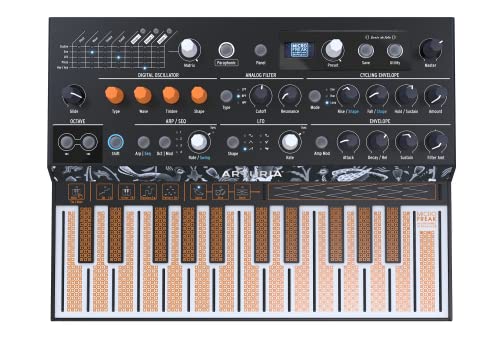
- 17 paraphonic oscillator modes and analog filter
- Pressure-sensitive 25-key surface with aftertouch
- Sequencer, modulation matrix, CV, USB, and MIDI
Best For: Compact experimental textures and evolving sequences
Best Acid Bass Workhorse

- Fully analog bass-synth signal path
- 128 patterns with intuitive sequencing
- MIDI, Sync, and USB-C connectivity
Best For: Live acid basslines and sequenced parts
Best Pocket Retro Accent

- Iconic retro analog-style sound
- Stylus control across three octaves
- Battery-powered with speaker and headphones
Best For: Portable leads, accents, and beginner-friendly performance
Best Compact Sound-Design Option

- Compact alloy-steel mini synthesizer
- MIDI connectivity for compatible gear
- Lightweight design for portable rigs
Best For: Space-conscious MIDI-based band setups
Best Portable Analog Character

- Battery-powered with a built-in speaker
- Analog filter, LFO, delay, and sub-octave controls
- CV/Gate outputs for modular integration
Best For: Hands-on analog textures and portable band setups
Best Plug-and-Play FM Value
M-VAVE Wireless FM Synthesizer

- 128 presets and six-operator FM synthesis
- Built-in effects, arpeggiator, and 16-step sequencer
- USB, Bluetooth, and 3.5mm MIDI connectivity
Best For: Accessible portable sounds and quick band arrangements
Best Portable FM Workstation

- Six-operator FM engine with 128 presets
- Sequencer, arpeggiator, effects, and 12-voice polyphony
- USB-C, Bluetooth MIDI, and up to 12-hour battery
Best For: Portable production and live electronic performance
Thick Analog Power – Behringer Poly D
For small bands needing a substantial analog voice, the Behringer POLY D combines four VCOs with four-voice polyphonic or paraphonic operation. Its 37 velocity-sensitive, semi-weighted full-size keys, sequencer, arpeggiator, chorus, and distortion make it a flexible centerpiece for basses, chords, and lead parts.
Best For: Small bands wanting fat analog tones and hands-on performance controls.
Pros:
- Four VCOs deliver warm, bass-heavy analog sound.
- Supports mono, unison, polyphonic, and paraphonic modes.
- Includes a 32-step sequencer, arpeggiator, stereo chorus, and distortion.
- Full-size velocity-sensitive keys suit live playing.
Cons:
- At 26.1 pounds, it is less convenient to transport.
- Its 31.4-inch width may challenge compact setups.
The Poly D is a strong choice when a small band values classic analog weight over maximum portability. Its multiple operating modes help cover bass, unison, and chord duties from one instrument.
Portable All-in-One – Akai MPK Mini Play MK3
The Akai MPK Mini Play MK3 is a practical option for small bands that need synthesizers for small bands without adding a large keyboard to the setup. It combines 25 dynamic mini keys, built-in sounds, a speaker, drum pads, an arpeggiator, and USB MIDI in a compact, battery-capable design.
Best For: Portable songwriting, rehearsals, beat-making, and compact MIDI setups.
Pros:
- Over 100 internal drum and instrument sounds work without a computer.
- Built-in speaker and battery operation support mobile use.
- Eight velocity-sensitive MPC pads, eight knobs, arpeggiator, and note repeat expand performance options.
- Includes MPC Beats, AIR instruments, Melodics lessons, and a Splice trial.
Cons:
- Its 25 mini keys provide less playing space than a full-size keyboard.
- Batteries are not included.
- It is a controller and compact sound source rather than a dedicated analog synthesizer.
Choose the MPK Mini Play MK3 when portability and versatility matter more than full-size keys or deep analog synthesis. It is especially useful for bands that sketch parts, trigger beats, or control software from different locations.
Expressive Moog Bass – Moog Messenger
The Moog Messenger gives small bands a portable monophonic analog instrument with two wavefolding VCOs, a sub-oscillator, and a versatile ladder filter. Its 32 full-size velocity- and aftertouch-sensitive keys, onboard sequencing, presets, and broad connectivity make it well suited to expressive bass and lead work.
Best For: Players who want classic Moog-style bass and leads with modern sequencing and modulation.
Pros:
- Two continuously variable-shape VCOs, sync, FM, and a sub-oscillator provide broad mono sounds.
- The 2- or 4-pole filter offers low-pass, band-pass, and high-pass responses.
- Full-size keys include velocity and aftertouch for expressive playing.
- Features a 64-step sequencer, arpeggiator, 256 presets, CV, MIDI, USB-C, and external audio input.
Cons:
- Monophonic operation limits simultaneous chord playing.
- Its 5.14-kilogram weight may be more than some portable rigs require.
The Messenger is a focused choice for bands that need a commanding bass or lead voice rather than an all-purpose polyphonic keyboard. Its expressive keybed and extensive connections leave room for both live performance and expanded hardware setups.
Experimental Sound Lab – Arturia MicroFreak
The Arturia MicroFreak is a compact hybrid option for small bands that want unusual textures without carrying a full-size instrument. Its digital oscillator engines, resonant analog filter, pressure-sensitive 25-key surface, sequencer, modulation matrix, and CV connectivity make it particularly suited to evolving and experimental parts.
Best For: Bands seeking distinctive textures, evolving sequences, and compact experimental control.
Pros:
- Offers 17 paraphonic oscillator modes spanning physical modeling, wavetable, vocoder, and other sounds.
- Individual note pressure and aftertouch provide expressive control from the flat key surface.
- Spice and Dice sequencing, automation recording, and a 5×7 modulation matrix encourage sound experimentation.
- Provides CV, USB, MIDI, audio, and headphone connectivity.
Cons:
- The 25-key touch-plate design may feel less familiar than conventional keys.
- Its experimental architecture may require more learning than a straightforward preset keyboard.
- It is not designed primarily for traditional full-size keyboard performance.
MicroFreak stands out when a small band needs sounds that cut beyond standard piano, bass, and lead presets. Its low weight and flexible connections also make it easy to add to a hardware, modular, or computer-based setup.
Best Acid Bass Workhorse – Donner Essential B1
For small bands looking for synthesizers for small bands, the Donner Essential B1 is a focused choice for adding analog basslines, sequenced patterns, and playable effects without a complicated workflow. Its one-VCO analog design, intuitive step sequencer, and 128-pattern memory make it practical for rehearsals and live performance.
Best For: Bands needing warm, classic acid-style bass and hands-on pattern performance.
Pros:
- Fully analog signal path with saturation and delay effects.
- Intuitive step sequencer with 128 pattern-memory slots and Song Mode support.
- Haptic performance pads and an eight-mode arpeggiator encourage live jamming.
- USB-C, dual five-pin MIDI, and Sync I/O support hardware and DAW setups.
Cons:
- Its one-VCO, one-VCF, and one-VCA architecture is focused rather than highly versatile.
- The bass-oriented sound profile may not cover every band’s melodic or atmospheric needs.
The Essential B1 makes the most sense when a small ensemble wants a dedicated, playable bass-synth role. It offers useful sequencing and connectivity while keeping the sound engine straightforward.
Best Pocket Retro Accent – Stylophone Original
The Stylophone Original is a compact option for synthesizers for small bands when portability and distinctive character matter more than extensive sequencing. Its stylus-controlled metal surface produces an iconic retro sound, while the built-in speaker and headphone output make it easy to use away from a full setup.
Best For: Beginners, experimental performers, and bands wanting a memorable retro lead or accent sound.
Pros:
- Three octaves with an optional vibrato effect and recognizable analog-style tone.
- Stylus-and-touch-surface control is simple and expressive.
- Small, battery-powered design fits in a pocket and includes a built-in speaker.
- Headphone and 3.5mm connectivity support quiet practice and recording connections.
Cons:
- Its compact interface offers fewer conventional keyboard and sound-design controls.
- It runs on three AA batteries, which requires keeping spares available for performances.
The Stylophone is best treated as a character instrument rather than the main keyboard for a band. It can add a playful vintage voice or quick performance layer with almost no setup.
Best Compact Sound-Design Option – Behringer PHARA-O MINI
The Behringer PHARA-O MINI is worth considering among synthesizers for small bands when a compact sound-design instrument is the priority. Its small footprint and MIDI connection suit streamlined rigs, though the supplied product information provides limited detail about its controls, sounds, and sequencing features.
Best For: Space-conscious setups that need a compact MIDI-connected synthesizer.
Pros:
- Compact dimensions make it suitable for crowded rehearsal or performance spaces.
- MIDI connectivity supports integration with compatible music equipment.
- Lightweight design at approximately 0.65 kg is convenient for transport.
Cons:
- The available specifications do not describe its synthesis architecture or sound library.
- The supplied notes do not confirm onboard speakers, battery operation, or sequencing functions.
Choose the PHARA-O MINI when footprint and MIDI integration are more important than documented feature depth. Confirm the available controls and connections before making it the centerpiece of a small-band rig.
Best Portable Analog Character – Stylophone GENX-2
For small bands seeking synthesizers for small bands, the Stylophone GENX-2 is a compact option for adding distinctive analog basses, leads, and effects without taking up much space. Its battery operation and built-in speaker also make it practical for rehearsals, portable setups, and quick songwriting sessions.
Best For: Small-band players who want hands-on analog sound design, portable performance, and CV/Gate integration.
Pros:
- Battery-powered design with built-in speaker, headphone output, and audio output.
- Analog sound-shaping tools include an LFO, resonant low-pass filter, attack/decay envelope, PWM, and dual sub-octave switches.
- CV and Gate outputs support modular and semi-modular equipment, while the expression strip adds performance control.
Cons:
- The stylus-based two-octave keyboard may require adjustment for players used to conventional keys.
- Its compact size favors portability over a larger playing surface.
The GENX-2 stands out when a small band needs characterful analog textures and flexible hardware connectivity in a very portable instrument. It is especially appealing for players who enjoy shaping sounds rather than relying only on presets.
Best Plug-and-Play FM Value – M-VAVE Wireless FM Synthesizer
Among synthesizers for small bands, this M-VAVE model offers a broad set of ready-to-use sounds and performance tools in a compact, battery-powered format. Its built-in speaker, arpeggiator, sequencer, and multiple MIDI options can help a small group add electronic parts without assembling a large rig.
Best For: Beginners and small-band performers who want presets, FM synthesis, sequencing, and wireless MIDI in one compact unit.
Pros:
- Includes 128 factory presets covering pianos, strings, brass, basses, and electronic sounds.
- Six operators and 32 algorithms provide genuine FM sound design options.
- Built-in effects, seven arpeggiator modes, a 16-step sequencer, and USB, Bluetooth, and 3.5mm MIDI connectivity add flexibility.
Cons:
- The 27-key silicone keyboard may feel different from a standard keyboard.
- Its plastic and silicone construction prioritizes portability over a traditional instrument feel.
This is a practical all-in-one choice for small bands that need quick access to varied sounds and rhythm-generating features. It works particularly well when portability and straightforward operation matter as much as detailed sound sculpting.
Best Portable FM Workstation – M-VAVE FM-1 Orange
The M-VAVE FM-1 Orange is one of the more complete synthesizers for small bands, combining FM sound design, sequencing, effects, MIDI control, and battery operation in a compact unit. Its portability makes it suitable for rehearsals, live electronic accents, and creating parts away from a full studio.
Best For: Producers and live performers who want a compact FM workstation with long battery life and broad MIDI compatibility.
Pros:
- Six-operator FM engine, 32 algorithms, 128 presets, DX7 SysEx import, and up to 12-voice polyphony.
- Includes a seven-mode arpeggiator, 16-step sequencer, six effects, and a color TFT display.
- Offers USB-C, Bluetooth BLE MIDI, 3.5mm MIDI, Bluetooth audio playback, and up to 12 hours of battery life.
Cons:
- The 27-key silicone keyboard is compact and may not suit players wanting full-size keys.
- Its extensive FM editing capabilities may be more than beginners need for simple preset-based playing.
With its integrated production features and extended battery life, the FM-1 Orange is well suited to small bands that want one portable device to cover synth parts, loops, effects, and MIDI duties. It offers the most workstation-like feature set of these options while remaining backpack-friendly.
How We Picked the Best Synthesizers for Small Bands
We focused on instruments that make sense in compact live rigs and rehearsal spaces. Our selection considers sound variety, hands-on controls, portability, keyboard or playing interface, connectivity, onboard sequencing or effects, and how quickly each synthesizer can contribute a usable part. We included analog, digital, FM, bass-focused, pocket, and MIDI-controller options because small bands have different needs.
For a live group, practical design matters as much as specifications. A synthesizer with clear controls, reliable outputs, useful presets, and manageable power requirements can be more valuable than a larger instrument with deeper but slower programming options.
Quick Comparison
| Type | Best For | What to Look For |
|---|---|---|
| Polyphonic analog | Chords and warm pads | Voice count, full-size keys, filter controls |
| Monophonic analog | Bass and lead lines | Keyboard feel, sequencer, modulation |
| Digital or FM | Bright textures and variety | Presets, algorithms, display, effects |
| Bass synthesizer | Sequenced low-end parts | Pattern memory, filter, distortion or delay |
| Pocket synth | Portable setups and experimentation | Built-in speaker, battery operation, outputs |
| MIDI controller | Software or external sound modules | USB compatibility, controls, power needs |
Key Buying Factors for Synthesizers for Small Bands
Playing Role and Sound Range
Decide whether the instrument will supply chords, bass, leads, pads, effects, or several of these. Polyphonic models are more useful for harmonic parts, while monophonic and bass synths can provide stronger dedicated lines. FM instruments are useful when you need crisp bells, digital keys, metallic tones, or sounds that contrast with guitars and acoustic instruments.
Portability and Stage Control
Measure your stand, pedalboard, and transport space before choosing a keyboard. Compact models are easier to carry, but very small keys or stylus-based interfaces may be less comfortable for extended playing. Hands-on filter, envelope, oscillator, and effect controls are valuable when sounds need to change during a song.
Connections and Power
Check whether you need standard audio outputs, headphones, MIDI, USB, CV/Gate, or Bluetooth. A controller may produce no sound without a computer or external module, while a standalone synth can connect directly to a mixer or amplifier. Battery operation and built-in speakers are convenient for practice but should not replace checking the instrument’s live audio connectivity.
Presets, Sequencing, and Effects
Preset memory speeds up set changes, and onboard sequencers or arpeggiators can add movement without another performer. Built-in delay, chorus, saturation, or modulation effects can also reduce the need for external pedals, although dedicated effects may offer greater control.
Who Should Buy Which Synthesizers for Small Bands?
Choose a polyphonic analog model if your band needs playable chords, pads, and classic synthesizer warmth. Pick a monophonic analog keyboard for focused bass and lead work, especially when tactile controls matter. A bass-focused sequencer is a good fit for electronic, indie, and groove-oriented groups that want repeating low-end patterns.
Digital and FM models suit players who want broad preset libraries and sounds that stand apart from traditional analog tones. Pocket instruments are best for highly portable rigs, songwriting, and experimental parts. Finally, choose a MIDI keyboard when your sounds already live in a laptop, tablet, or external sound module; it can be the lightest option, but only if your wider setup is dependable.