
Finding the right synthesizer under $1,000 means balancing sound, hands-on control, keyboard size, portability, and workflow. This lineup covers analog, digital, modeling, and hybrid instruments for beginners, producers, performers, and experienced players.
Whether you want warm polyphonic chords, deep bass, expressive leads, or an all-in-one production keyboard, these options offer distinct strengths without reaching premium-synth prices.
Best 10 Synthesizers Under 1000 Picks for 2026
Fat Analog Powerhouse

- Four VCOs for thick analog tones
- Four-voice polyphonic or paraphonic operation
- 37 velocity-sensitive full-size keys
Best For: Players seeking a substantial analog synth for basses, leads, chords, and sequences
Portable Sound Explorer

- One-pound micro polysynth design
- SH-101-inspired basses and leads
- Wave manipulation and onboard sequencing
Best For: Mobile creators and beginners wanting an intuitive, compact synth
Accessible Analog Classic

- Four-voice true analog synthesis
- 37 slim keys and 200 presets
- Polyphonic step and motion sequencer
Best For: Players wanting approachable analog polyphony for studio or live use
Experimental Hybrid Lab
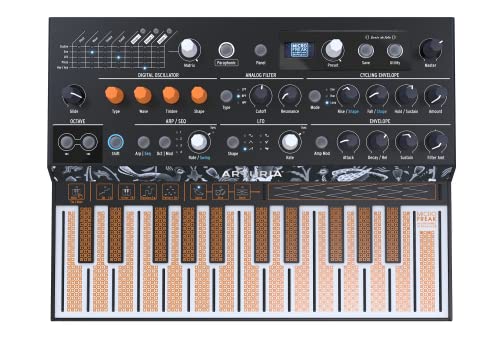
- 17 digital oscillator modes with analog filter
- 25-key PCB keyboard with polyphonic aftertouch
- CV, USB, MIDI, and creative sequencing
Best For: Advanced users pursuing experimental textures and expressive modulation
Best Analog Bass Synth

- Two analog oscillators plus sub-oscillator
- Dual filter designs for flexible tone shaping
- Arpeggiator and step sequencer included
Best For: Analog basses, leads, and hands-on sound design
Best Portable FM Synth

- Four-operator FM sound engine
- 37-key mini keyboard with initial touch
- Built-in speakers, battery power, and phrase looper
Best For: Portable composition and expressive FM sounds
Best Feature-Rich Monosynth

- Wavefolding VCOs with sync and frequency modulation
- Expressive full-size keys with velocity and aftertouch
- Sequencer, 256 presets, CV, MIDI, and USB-C
Best For: Advanced analog performance and studio integration
Best All-Around Workstation

- 128-note polyphony for live playing and sequences
- USB audio and 16-channel MIDI over one cable
- Motif engine and vintage-style modeled effects
Best For: Home producers and performers needing versatile USB production features
Best Compact Performance Synth

- 18-voice analog modeling engine
- Eight Animate buttons for live sound changes
- Built-in microphone, vocoder, and VocalTune
Best For: Performers and vocalists wanting portable hands-on control
Best for Analog Sequencing

- Monophonic analog design for basses and leads
- 16-step sequencer with real-time editing
- Motion sequencing, DRIVE, and expanded LFO
Best For: Electronic producers focused on hands-on bass and lead sequences
Fat Analog Powerhouse – Behringer POLY D
For shoppers comparing synthesizers under 1000, the Behringer POLY D stands out for its substantial analog architecture and hands-on format. Four VCOs, four-voice polyphonic or paraphonic operation, full-size keys, and classic ladder-filter circuitry make it suited to warm, bass-heavy tones and expressive performance.
Best For: Players who want a full-size analog synth for rich basses, leads, chords, and sequenced performances.
Pros:
- Four VCOs deliver thick, warm analog sounds.
- Supports mono, unison, polyphonic, and paraphonic modes.
- Includes 37 velocity-sensitive, semi-weighted full-size keys.
- Built-in sequencer, arpeggiator, chorus, distortion, and ladder filter expand performance options.
Cons:
- At 26.1 pounds, it is less portable than compact alternatives.
- Its 31.4-inch width requires considerable desk or stand space.
The POLY D is a strong choice when sound weight and traditional controls matter more than portability. Its broad analog voice structure and performance features make it especially appealing for studio players and live electronic musicians.
Portable Sound Explorer – Roland AIRA Compact S-1
Roland AIRA Compact S-1 Tweak Synth | Ultra-Portable Micro Polysynth. Advanced Tools
Check Price On AmazonAmong synthesizers under 1000, the Roland AIRA Compact S-1 is a particularly portable option for spontaneous sound creation. Inspired by the SH-101, this micro polysynth combines hands-on controls, wave manipulation, sequencing, and performance-focused features in a one-pound design.
Best For: Beginners, mobile producers, and experienced creators who want a compact synth for basses, leads, patterns, and experimentation.
Pros:
- Compact one-pound design is easy to carry.
- Offers snappy basses and expressive leads inspired by the SH-101.
- Includes wave manipulation and onboard sequencing.
- Hands-on controls and an intuitive workflow support quick idea generation.
Cons:
- Its micro format may be less suitable for players seeking a conventional full-size keyboard.
- The supplied notes do not specify key count or detailed connectivity.
The S-1 makes sense when portability and immediacy are priorities. It provides an approachable entry point while retaining enough sound-shaping and sequencing capability for more experienced synth users.
Accessible Analog Classic – Korg minilogue
The Korg minilogue is a well-rounded choice for anyone comparing synthesizers under 1000 and looking for true analog sound in a compact instrument. Its four-voice polyphony, 37 slim keys, 200 presets, built-in sequencer, and tape-style delay make it useful for both learning synthesis and building complete parts.
Best For: Beginners and working musicians who want versatile analog polyphony with sequencing and studio-friendly sound design tools.
Pros:
- Four-voice analog polyphony produces warm, punchy tones.
- Includes 200 presets plus editable sound-design controls.
- 37 slim keys offer a responsive, compact playing surface.
- Polyphonic step and motion sequencing, delay, and an oscilloscope add practical workflow features.
Cons:
- Four voices may limit very dense arrangements.
- Slim keys may not suit players who prefer full-size keybeds.
The minilogue balances accessibility and depth effectively. It is a practical all-purpose analog synth for users who want hands-on programming, playable polyphony, and built-in sequencing without moving to a larger instrument.
Experimental Hybrid Lab – Arturia MicroFreak
For adventurous shoppers researching synthesizers under 1000, the Arturia MicroFreak offers an unusually broad hybrid sound palette in a lightweight package. Its digital oscillator modes, resonant analog filter, pressure-sensitive PCB keyboard, modulation matrix, and creative sequencer features favor experimentation over conventional keyboard feel.
Best For: Sound designers, electronic musicians, and advanced users who want unusual textures, expressive touch control, and flexible modulation.
Pros:
- Offers 17 oscillator types spanning physical modeling, wavetable, vocoder, and other digital flavors.
- 25-key touch keyboard provides polyphonic aftertouch and pressure sensing.
- Spice, Dice, automation, and modulation-matrix features encourage evolving patterns.
- CV, USB, and MIDI connectivity supports DAW, modular, and external-synth setups.
Cons:
- The flat PCB keyboard may feel unfamiliar to traditional keyboard players.
- Its advanced feature set can require more learning than a simpler subtractive synth.
- The supplied notes identify it as best suited to advanced users.
The MicroFreak is less about recreating a traditional instrument experience and more about opening up new sound-design routes. Choose it when experimentation, touch expression, and connection to modular or computer-based systems are central to your workflow.
Best Analog Bass Synth – Bass Station II
If you want one of the more focused synthesizers under 1000 for basses and leads, the Novation Bass Station II is a practical choice. Its two analog oscillators, sub-oscillator, switchable filters, and hands-on controls cover everything from mellow tones to aggressive, resonant sounds.
Best For: Bass lines, lead sounds, hands-on analog sound design, and compact MIDI-based setups.
Pros:
- Two tunable analog oscillators, a sub-oscillator, noise, and ring modulation provide broad sound-shaping options.
- Classic multimode and Acid filters offer low-pass, high-pass, and band-pass filtering with 12- and 24dB/octave slopes.
- Pattern-based arpeggiator and step sequencer support real-time notes, ties, rests, and rhythms.
- Includes 128 patch locations, USB, five-pin MIDI, 25 full-size keys, and aftertouch.
Cons:
- Its monophonic design is primarily suited to single-note bass and lead parts.
- The plastic body may feel less substantial than a metal-panel instrument.
The Bass Station II stands out when direct control and classic analog character matter more than polyphony. It is especially useful for producers who want a compact instrument with sequencing, patch storage, and flexible external connectivity.
Best Portable FM Synth – REFACE DX
The Yamaha REFACE DX is a portable option among synthesizers under 1000, using a four-operator FM sound engine for dynamic, expressive tones. Its 37-key mini keyboard, built-in speakers, battery power, and phrase looper make it convenient for sketching ideas away from the main studio.
Best For: Portable composing, FM synthesis, quick song sketches, and players who value built-in speakers.
Pros:
- Four-operator FM synthesis delivers an expressive alternative to traditional subtractive synthesis.
- Thirty-two voice memory locations make it easy to save and recall favorite sounds.
- Built-in phrase looper supports capturing ideas or jamming.
- Includes 37 mini synth keys with initial touch, built-in speakers, battery power, and a headphone jack.
Cons:
- The mini keys may be less suitable for players who prefer full-size keyboards.
- Its listed connectivity centers on auxiliary and 3.5mm connections rather than a broad MIDI specification.
The REFACE DX is a strong fit for musicians who want an expressive FM instrument that can be played almost anywhere. It prioritizes portability and immediate idea capture over a larger keyboard format or extensive studio connectivity.
Best Feature-Rich Monosynth – MOOG Messenger
The MOOG Messenger brings an extensive analog feature set to the synthesizers under 1000 category. It combines two wavefolding VCOs, a flexible ladder filter, full-size expressive keys, sequencing, presets, and CV connectivity in a portable monophonic format.
Best For: Producers and performers who want a modern Moog-style monosynth with deep modulation, sequencing, and hardware integration.
Pros:
- Two continuously variable-shape VCOs include sync, frequency modulation, and a sub-oscillator.
- The ladder filter offers 2- or 4-pole low-pass, band-pass, and high-pass responses with resonance bass compensation.
- Thirty-two full-size semi-weighted keys provide velocity and aftertouch control.
- Includes a 64-step sequencer, arpeggiator, 256 presets, six CV patch points, five-pin MIDI, and MIDI over USB-C.
Cons:
- As a monophonic synthesizer, it is designed mainly for single-note parts.
- Its 5.14 kg weight and larger footprint make it less travel-friendly than smaller portable synths.
The Messenger is compelling for users who want extensive hands-on control without giving up modern performance features. Its expressive keyboard, advanced oscillator options, sequencer, and broad connectivity make it particularly versatile for studio and live setups.
Best All-Around Workstation – Yamaha MX49BK
The Yamaha MX49BK is a strong choice for musicians seeking synthesizers under 1000 with broad sound-shaping and production features. Its 49-key design, 128-note polyphony, Motif Sound Engine, and class-compliant USB connectivity make it suited to both live performance and computer-based recording.
Best For: Home producers, keyboard players, and performers who need versatile sounds plus USB audio and MIDI recording.
Pros:
- 128-note polyphony supports live playing and full 16-track sequences with fewer dropouts.
- USB carries stereo audio and 16 channels of MIDI data through one cable.
- Motif Sound Engine supports layering, zoning, switching, cycling, and randomizing up to eight elements.
- Virtual Circuit Modeling recreates the behavior of vintage effects and signal processors.
Cons:
- The 38.6-inch chassis is less compact than a mini-key synthesizer.
- Its extensive production features may be more than a beginner needs.
The MX49BK stands out when flexibility and polyphony matter more than portability. It is particularly practical for players who want a single keyboard to cover live sounds, sequencing, and direct computer recording.
Best Compact Performance Synth – Novation MiniNova
The Novation MiniNova is a compact option among synthesizers under 1000, combining analog modeling, performance controls, and vocal processing. It offers up to 18 voices, 256 presets, eight Animate buttons, and a built-in microphone for expressive sound design and live use.
Best For: Performers, electronic musicians, and vocalists who want portable controls, built-in effects, and vocoder-style processing.
Pros:
- Up to 18-voice polyphony supports basses, leads, pads, and other layered sounds.
- Eight backlit Animate buttons enable hands-on performance changes.
- Built-in microphone and VocalTune add vocal effects and automatic tuning to played notes.
- 256 presets and storage for 128 user sounds make browsing and saving patches convenient.
Cons:
- The 37 mini-key layout may feel limiting for players who prefer full-size keys.
- Its plastic body prioritizes portability over a heavier construction.
MiniNova is a good fit when immediate performance control and unusual vocal sounds are priorities. Its small footprint and included gooseneck microphone make it especially appealing for compact setups.
Best for Analog Sequencing – Korg monologue
The Korg monologue is a focused pick among synthesizers under 1000 for players who want an analog instrument with a hands-on sequencer. Its monophonic design, 16-step controls, motion-sequencing functions, DRIVE circuit, and expanded LFO are geared toward basses, leads, and rhythmic sequences.
Best For: Electronic musicians and producers creating monophonic bass lines, cutting leads, and evolving step sequences.
Pros:
- 16 step buttons support fast real-time sequence editing.
- Parameter-lock-style controls enable motion sequencing by combining a button press with knob movement.
- DRIVE adds richer bass and more cutting lead tones.
- Expanded LFO offers higher rates and deeper modulation, while the revised filter adds bite.
Cons:
- Its monophonic architecture is designed for one note at a time rather than chords.
- The feature set is more specialized than a general-purpose workstation.
The monologue is best viewed as a dedicated analog groove and lead instrument rather than an all-purpose keyboard. Choose it when tactile sequencing and assertive monophonic sounds are central to your setup.
How We Picked the Best Synthesizers Under 1000
We focused on instruments that offer strong sound design potential, reliable controls, useful sequencing or performance features, and a clear value advantage at their price. The selection includes analog, FM, wavetable, modeling, and workstation-style synthesizers so shoppers can compare different approaches rather than choosing between near-identical products.
We also considered keyboard format, portability, connectivity, polyphony, preset access, and whether each synthesizer suits live performance, studio production, or learning. Because “best” depends heavily on workflow, the guide emphasizes practical differences instead of naming one universal winner.
Quick Comparison
| Synthesizer | Best For | Key Strength |
|---|---|---|
| Behringer POLY D | Analog chords and bass | Four-voice architecture and full-size keys |
| Roland AIRA Compact S-1 | Portable production | Compact, battery-friendly groovebox workflow |
| Korg minilogue | Accessible analog polyphony | Hands-on controls and built-in sequencer |
| Arturia MicroFreak | Experimental sound design | Flexible digital oscillator and expressive keyboard |
| Novation Bass Station II | Bass and lead lines | Focused analog monosynth design |
| Yamaha REFACE DX | FM tones and portability | Expressive FM synthesis in a compact keyboard |
| MOOG Messenger | Premium analog mono sounds | Powerful Moog-style bass and lead architecture |
| Yamaha MX49 | Complete music production | Broad sound library and performance features |
| Novation MiniNova | Versatile live patches | Deep analog-modeling capabilities |
| Korg monologue | Affordable analog sequencing | Monophonic bass and lead workflow |
Key Buying Factors for Synthesizers Under 1000
Synthesis Type
Analog instruments excel at immediate, tactile basses, leads, and pads. FM and digital designs can produce sharper electric-piano tones, metallic textures, and complex motion. Modeling instruments typically provide the broadest range of sounds, while workstation-style keyboards prioritize variety and arrangement features.
Polyphony and Keyboard Size
Monosynths play one note at a time and are ideal for bass and lead parts. Polyphonic models are better for chords and layered pads. Full-size keys are more comfortable for traditional playing, while compact keyboards and desktop formats are easier to transport and fit into crowded setups.
Sequencing and Connectivity
A built-in sequencer can turn a simple patch into a complete performance idea. Check for MIDI, USB, audio inputs, sync options, and outputs that match your existing gear. If you plan to integrate software or drum machines, connectivity may matter more than the number of presets.
Hands-On Control and Portability
Dedicated knobs make learning synthesis faster and live tweaking more natural. Smaller instruments save space but may require menus or external controllers. Also consider power requirements, construction, and whether the unit is intended for a studio desk, stage, or travel bag.
Who Should Buy Which Synthesizers Under 1000?
Choose the Korg minilogue or Behringer POLY D if you want hands-on analog polyphonic textures and playable keyboards. For focused bass and lead work, the Novation Bass Station II, MOOG Messenger, or Korg monologue are strong fits. The Arturia MicroFreak and Novation MiniNova suit producers who want unusual sounds and broad patch flexibility.
Pick the Yamaha REFACE DX for compact FM synthesis and expressive portable playing, or the Roland S-1 for a small, mobile setup built around quick ideas. If you want one keyboard to cover many production roles, the Yamaha MX49 is the most workstation-oriented option. Among these Synthesizers Under 1000, the best choice is the one whose synthesis engine, controls, and format match how you actually make music.